
The legal history of the dispute spans over three decades. In India Cement v. State of TN (1989), a seven-judge Bench treated royalty on minerals as a tax and consequently held the impugned State cess on royalty to be beyond legislative competence. However, in State of West Bengal v. Kesoram Industries Ltd. (2004), a five-judge Bench took the contrary view and treated the relevant observation in India Cement as a typographical error. The conflict was ultimately referred to a nine-judge Bench in MADA. By an 8:1 majority, the Court held that royalty is not a tax, but rather a consideration paid for the enjoyment of mineral rights. In other words, royalty is a contractual obligation owed by the mining lessee to the owner of the mineral and is intrinsically linked to the relationship governing extraction, whereas a tax is a compulsory payment exacted by the State in the exercise of its sovereign authority. Payment of royalty under the MMDR Act therefore did not exhaust the State’s taxing power under Entry 50 of the State List. The Court further held that the MMDR Act, as it then stood, did not impose any limitation on that power. Furthermore, MADA recognised that Entry 50 itself permits Parliament, by a law relating to mineral development, to impose limitations upon the power of States to tax mineral rights. Therefore, Parliament could enact a law limiting taxation under Entry 50.
On the other hand, the position of mineral-bearing land was different. The Court held that land does not cease to be land merely because it contains minerals. It remains land within Entry 49 of the State List, and hence taxable thereunder. A tax on such land does not become a tax on mineral rights merely because mineral quantity, value or royalty is used as its measure. The subject of a tax and the measure by which it is calculated are not the same thing. This mattered because Entry 49, unlike Entry 50, is not expressly made subject to limitations imposed by Parliament.
For States such as Jharkhand, Odisha and Chhattisgarh, this was not an abstract question of constitutional entries. Large quantities of mineral wealth are extracted from these States, while mining regions continue to bear the costs of displacement, ecological destruction, pressure on public infrastructure and poor access to basic services. MADA itself referred to the “resource curse” and connected the fiscal powers of mineral-producing States with their ability to fund welfare, health, education and infrastructure. The burden falls most heavily on already deprived Adivasi communities in States such as Jharkhand, Odisha, Assam and Telangana, for whom the environmental damage caused by extraction is likely to be permanent.
The stakes have been raised further by the growing importance of rare earth minerals, whose production and control have become significant with recent technological advancements. China accounts for about 70% of global production of rare earths and the United States for 13–14%, while India contributes only about 0.74 per cent. Large corporations are now looking towards States believed to be rich in rare earth minerals, such as Odisha, Jharkhand, West Bengal and Keralam. The timing is also significant. The ongoing wars and an energy crisis intensified by the USA–Israel war on Iran, have increased the demand for coal and iron, and have presented private capital with an opportunity for greater capture of natural resources, with fewer regulatory safeguards.
That contradiction has also been central to CPI(ML)’s position in Jharkhand and beyond. The party has repeatedly pointed to the coexistence of vast mineral wealth with poverty, unemployment, displacement and migration, and has argued that the benefits of extraction must first reach the people of the State through local employment, rehabilitation, environmental protection and regional development, instead of being transferred to large corporate groups.
Following MADA, the Jharkhand Assembly passed the Jharkhand Mineral-Bearing Land Cess Bill, prescribing different rates of cess for different minerals on the basis of the tonnage of the mineral extracted. CPI(ML) MLA Vinod Kumar Singh opposed this method and sought a levy linked to the market value of the mineral instead. The objection was straightforward: tonnage measures quantity, not the value being extracted at any given point of time. Further, different grades of the same mineral may carry different prices at the same time. Therefore, a levy tied to the market value would move with the economic value of the mineral, rather than requiring the State to repeatedly revise a fixed per-tonne rate as prices change.
The 2026 Amendment now restricts the field within which States can make such choices. The newly inserted Section 9D prohibits States from imposing taxes, cesses or other levies on “mineral rights” or “mineral-bearing lands”, whether calculated with reference to quantity, value, royalty or otherwise, except subject to conditions or restrictions prescribed by the Central Government. The amendment also extends the declaration of Union control under the MMDR Act to mineral-bearing lands. It operates retrospectively against covered levies which had not already been paid or recovered before its commencement. The effect is that dues which had not been paid before the amendment came into force stand written off. The pending dues to Odisha are estimated at nearly Rs 1–1.2 lakh crore, and those to Jharkhand at Rs 1.36 lakh crore.
The amendment is also seen as loosening the regulatory framework applicable to mining lessees. A company which begins mining a mineral not originally specified in its lease would no longer need a fresh lease deed, a change defended as encouraging diversity in mining. The concern is that this secures the lessee’s control over the land for the duration of the lease even where a change in the course of mining may harm the environment and the availability of water, with consequences that may be irreversible and on which scientific literature is still scarce. It is doubtful whether the District Mineral Foundation would be able to contain any further environmental degradation caused by such a change.
In relation to mineral rights, the Union can rely upon the power contained in Entry 50 itself. The more difficult question concerns mineral-bearing land. MADA had specifically held that such land remains within Entry 49, and that the use of mineral quantity or value to calculate the levy does not convert the levy into a tax on mineral rights. Section 9D now seeks to subject such levies as well to conditions fixed by the Centre. Jharkhand, Keralam, Telangana and Karnataka have decided to challenge the amendment in court, and the treatment of mineral-bearing land is likely to receive close scrutiny in those proceedings.
The Union government has defended the amendment by arguing that multiple State levies increase costs, create uncertainty and discourage investment in the mining sector. It has also emphasised that nearly 90 per cent of mining revenues accrue to the States. But the dispute is not confined to the percentage of revenue which ultimately reaches a State treasury. Royalty, auction premium, DMF contributions and other payments made under a framework determined substantially by Parliament and the Union government are different from a State exercising a taxing power which the Constitution gives to it directly. MADA had recognised room for States to make fiscal choices of their own. Section 9D now seeks to place those choices under Central conditions.
The manner in which the amendment was enacted has also drawn objection. CPI(ML) has condemned that it was passed without any debate or discussion in Parliament, in the name of transparency and ease of doing business, and that it allows private companies to extract ore at a fixed rate. The party has described this as reflecting a disregard for the federal structure and a colonial attitude towards the States, and as handing over existing and future mineral resources to corporate interests. The fiscal consequences for the States are considerable. Besides the dues written off, Odisha is expected to lose between Rs 12,000 crore and Rs 20,000 crore in revenue every year and Jharkhand about Rs 14,000 crore, with similar losses for Chhattisgarh, Assam, Telangana and Andhra Pradesh. A substantial fall in revenue would affect welfare schemes, education, health and basic infrastructure, which is precisely the connection that MADA drew between the fiscal powers of mineral-producing States and their ability to fund these services.
CPI(ML) in Jharkhand has opposed the amendment both as an attack upon the federal rights of mineral-producing States and as part of a wider process through which control over mineral resources is increasingly concentrated in the hands of the Centre and large corporations. Its opposition has linked the amendment to the older struggle over jal, jangal, zameen, and to the contradiction between the enormous value extracted from Jharkhand and the conditions in which large sections of its people continue to live.
The party has also linked this question to the struggle of farmers in Gondalpura and Barkagaon against the Adani coal project, opposing the transfer of village and forest land for mining and the resulting threat of displacement. For the party, control over mineral resources therefore also concerns resistance to corporate acquisition of land and demands for local employment, rehabilitation and environmental protection.
CPI(ML) places these struggles within a longer history of the fight over land. Ownership of land in India has never rested wholly with the Union, and it was through people’s struggles for rights over land, before, during and after colonial rule, that the country was freed from the feudal-zamindari monopoly over land. States’ control over land has, in the party’s view, to be understood from this perspective. It argues that changes in the laws on land ownership and acquisition over the past thirteen years have weakened community ownership and community rights over forests and other lands. In Jharkhand, community lands are being converted into government ownership through the Land Bank policy and through amendments to the Land Acquisition Act, 2013; the Panchayats (Extension to Scheduled Areas) Act, 1996 (PESA) is being systematically weakened; and the requirement of social and environmental impact assessment is regularly violated in acquiring land for mining and industrial projects. The 2026 Amendment, it is argued, will hasten this process of transferring land to corporations at the expense of the fundamental rights of local communities.
The question of State power over mineral revenue is therefore connected to a wider question of control over natural resources. Who decides the terms on which minerals are extracted is not separate from who bears the costs of extraction, who obtains employment, how affected communities are rehabilitated and where the resulting wealth is spent.
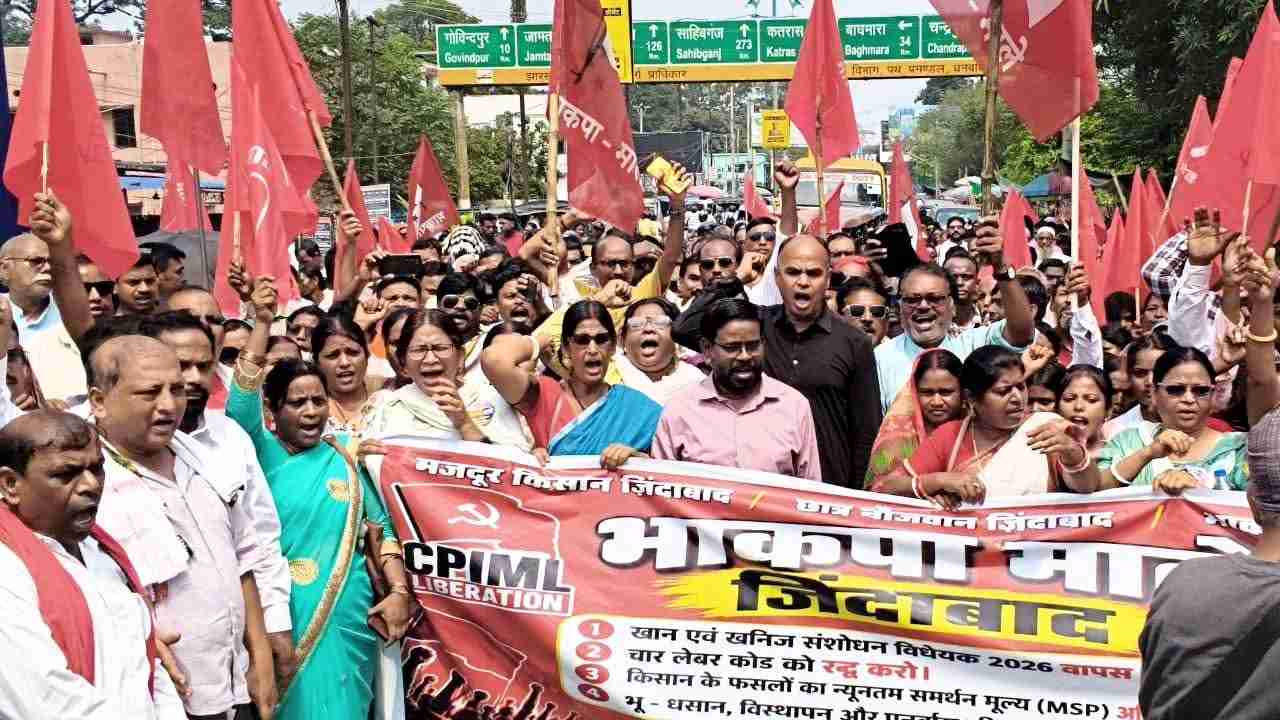
This opposition has also taken to the streets. On 9 September 2026, CPI(ML) held a large rally in Dhanbad, Jharkhand’s coal capital, demanding that the 2026 Amendment be scrapped. Politburo member Anand Mahto said that the transportation of minerals from Jharkhand would not be allowed if the Union government did not withdraw the amendment. The Jharkhand Mukti Morcha, the Biju Janata Dal and the Congress have also opposed it. The party has called for a countrywide movement against what it describes as the corporate appropriation of public resources, together with State-level struggles uniting local communities, to protect the constitutional rights of the States and to restore the rights of communities over land.
MADA had recognised the constitutional space available to mineral-producing States to answer those questions for themselves. The 2026 Amendment seeks to reduce that space by bringing both mineral rights and mineral-bearing lands within a fiscal framework subject to conditions prescribed by the Centre. For Jharkhand, the issue is not merely whether some share of mining revenue will continue to reach the State. It is whether the State will retain the constitutional power to decide the terms on which wealth extracted from its land contributes to its own finances and to the lives of the people who bear the consequences of that extraction.