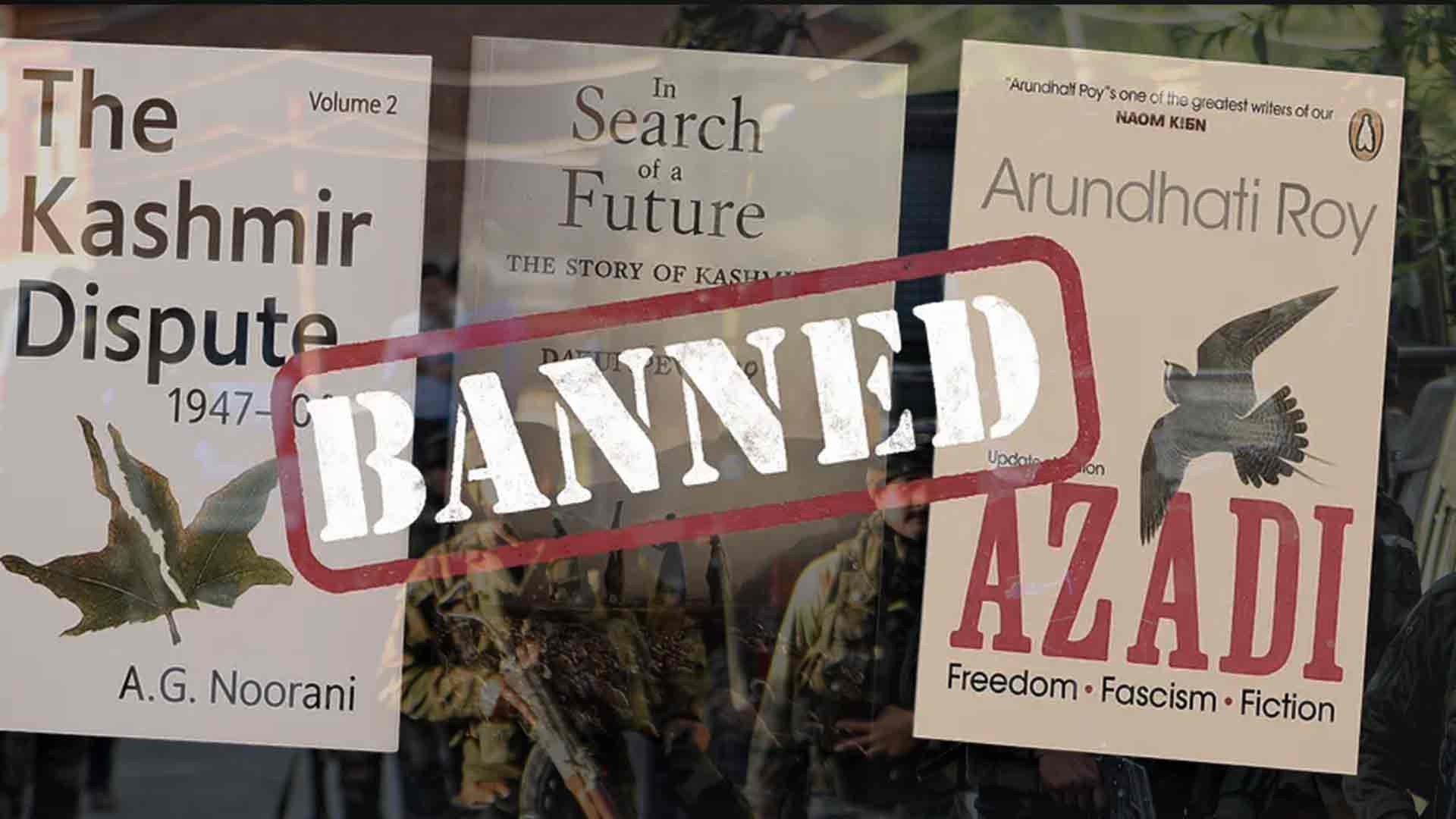
On January 13, 2025 inaugurating a strategic tunnel in Sonmarg area Prime Minister Narendra Modi dwelled on the issue of statehood for Jammu and Kashmir and said, ‘When Modi makes a promise, he fulfils it.......Right things will take place in the right time.’ Even six years after the abrogation of Article 370 evidently that time is yet to come, instead it’s time to further tighten the screws and strangle all possible forms of expression in the union territory. Almost seven months later 25 books written by luminaries across the world were banned under section 98 of the Bharatiya Nagarik Suraksha Sanhita. For five years and more the central government has been proclaiming that it’s all normal in the valley. In the space of just four months from the dastardly Pahalgam attack in April to the Book Ban, that claim has been proved to be as hollow as all the jumlas that has been peddled by the ruling dispensation since 2014.
Reasons given for this banning are : these books were misguiding the youth; instigating their participation in violence and terrorism; impacting youth by cultivating a culture of grievance, victimhood and terrorist heroism. Are these allegations true? For this let us have a cursory glance at some of the books, credibility of their authors, authenticity of whatever they have written. Among the list of books there is Azadi , by Arundhati Roy, Booker prize winner, perennially recognised as the ultimate anti-national; The Kashmir Dispute (1947-2012) by AG Noorani, former supreme court advocate and constitution expert; A Dismantled State:The Untold Story of Kashmir after Article 370 by Anuradha Bhasin, Editor of Kashmir Times, long acknowledged as the most authentic voice of J & K; Contested Lands by Sumantra Bose, political scientist, great grandnephew of Netaji Subhas Chandra Bose. Besides there are books by acclaimed international academics like Victoria Schofield, Christopher Snedden etc. All of them have impeccable credentials and a look at their books will reveal that they have only elaborated upon the complicated history of Kashmir, the ways to unravel it and depicted the ground realities prevalent there from time to time. What’s very strange is most of these books have been in public domain for last 30-40 years! In Noorani’s book there is an article written in 1964; Hafsa Kanjwal’s book Colonising Kashmir dwells on the 1950s and 60s when India consolidated its grip in the area; Muhammad Yusuf Saraf’s Kashmiris Fight for Freedom was published in two volumes in the 1970s, first volume describes events of 1819-1946 and is part of J & K’s historical archive! So why suddenly ban these books now? Have the youth in Kashmir suddenly become wary of instagram, reels and become bookworms?
Harassment of the media, communication blackout is nothing new in Kashmir: in 2010 SMS services were stopped for 3 years, in 2016 Kashmir Reader was forced to close shop and there have been numerous internet shutdowns since 2012. But after August, 2019, attack on journalists, curtailment of freedom of expression, censorship, surveillance has reached unprecedented heights. Besides, as Arundhati Roy writes, Kashmir is the most militarized zone in the world, with half a million security personnel posted there. Various agencies besides the Army, BSF, CRPF does intelligence gathering. “People live in terror of informers, double agents, and triple agents who could be anybody from old classmates to family members.” People in the valley always lived under a veil of fear but in the last six years that fear has become dense, ubiquitous, threatening, physically numbing. In the initial days even mobile network, broadband, landline, cable were shutdown. After 20 days landline was restored in selected districts. Internet was blocked for 145 days, longest in history. Even after that 2G was restored, high-speed net was restored almost after year and a half. Social Media, Facebook, Twitter (now X) et al simply vanished.
Most blatant attacks were launched on the Press and the Media. But it was done in a most subtle way, not the smash and kill style that the Israelis are following in Gaza. A situation has been created such that all communication channels have been choked, revenue has dried up leading to staff shortage and forcing proprietors to carry ‘all is well’ government ads, whole archives have been scrapped to erase previous protests, resistance, websites hauled down, and in a brazen show of power, even the Kashmir Press Club taken over by the police. The more intransigent ones have been hauled up, charged under stringent laws and incarcerated for unspecified period.
After the completion of the tunnel in Sonmarg the central government claims that Dil ki Doori and Delhi ki Doori , two out of Delhi’s three promises, has now been achieved. With improved communications it is being said that now one can travel from Delhi to Srinagar in only eight hours. And supposedly another promise of holding assembly elections and installing an elected government has also been fulfilled. Upgraded communications with road and rail bridges and shining metallic roads in remote areas of the country is now a priority for the government, be it in Chhattisgarh or Kashmir. Better communication means better business, opening up uncharted areas in the country to big business. By tinkering of existing laws that opened up land and residency rights and by abolishing Article 35A, land has been opened up for outsiders. Military camps are becoming ubiquitous and a big land hunt has been launched for industry and development. Large mining companies are making forays in the UT exploiting riverbeds and there has been a massive jump in stone quarrying. As regards the state government elected in October, 2024, the less said the better. The new chief minister Omar Abdullah promised press freedom and vowed to revive the old press club. However his power has been drastically curtailed and he has turned out to be a mere figurehead, a glorified Mayor or village head. He has also criticised the ban of books, but hardly anyone listens to him. The UT is basically run by Delhi and its man in Srinagar Lieutenant Governor Manoj Sinha.
Many are saying that in this age of PDF files, pirated books, e-books, massive net connectivity, every written word is available digitally and thus any attempt to ban books is a futile exercise. But they disregard the fear factor further strengthened by yet another coercive measure which will now discourage anyone from researching on the ground realities existing in the valley. Media has been strangled, rights suppressed, people silenced and now the attack has spread to the academic sphere erasing memories and histories. It’s unbelievable that works of Agha Shahid Ali, considered the leading poet in post-1947 Kashmir, and another distinguished bard, Bashrat Peer, have been dropped from Kashmir university curriculum. In the so-called ‘mainland’ they have already established that there was a temple in Ayodhya and not a mosque and Rana Pratap won the Battle of Haldighati and not Emperor Akbar! With heightened censorship and silencing of dissent more such falsehoods will now proliferate J & K.