
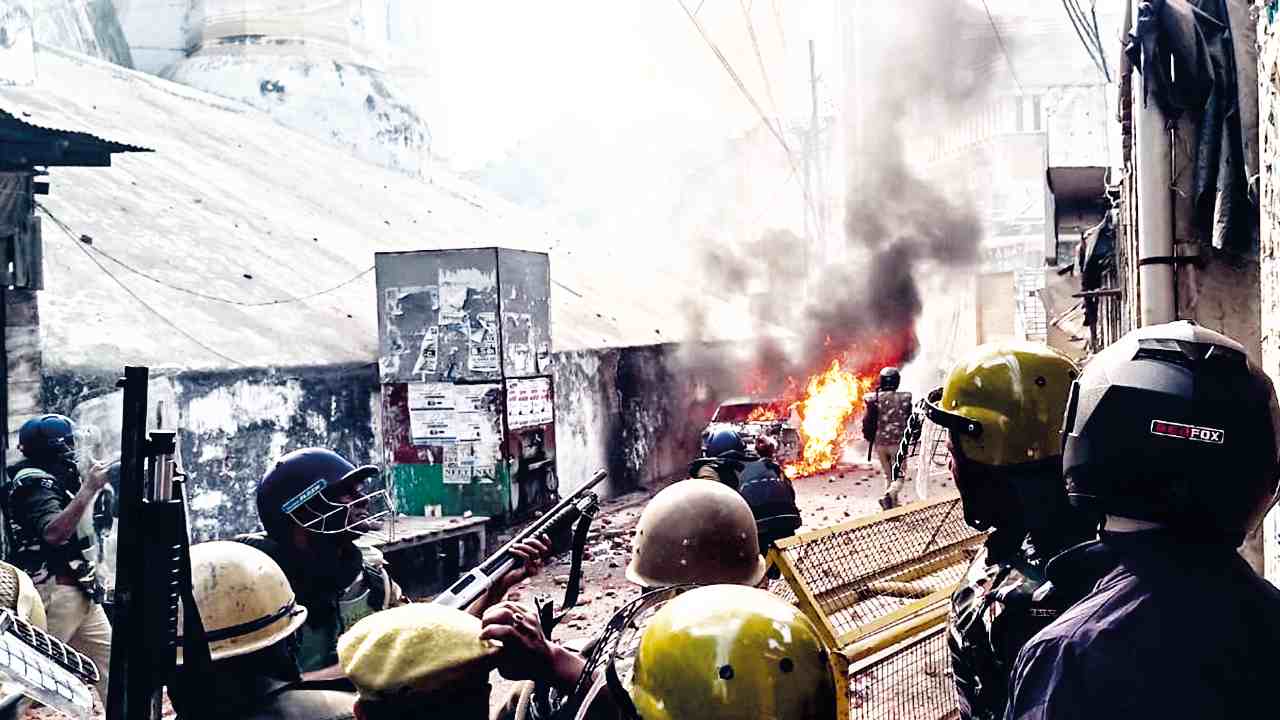
The disclosures in the report primarily characterise the Sambhal violence not as a sudden outburst of anger, but as a pre-planned conspiracy aimed at tarnishing the government's image, halting the survey of the Sambhal Shahi Jama Masjid, and exerting pressure on the local administration.
The inquiry commission has praised the police for containing the violence, stating that the deaths of the four people, five according to local residents, killed in the violence were not caused by police firing, but by firing carried out by rioters. Thus, the report has given a clean chit to the police.
The inquiry report has blamed Sambhal's Samajwadi Party MP Zia-ur-Rahman Barq, local MLA's son Suhail Iqbal, Jama Masjid Committee President Zafar Ali, and others, all of them Muslims. Furthermore, it has recommended that the police administration take strict action against them.
It is pertinent to closely examine the causes behind the Sambhal violence and take a look at the sequence of events, facts, and the policies pursued by the Yogi government at that time.
Violence in Sambhal
The violence in Sambhal occurred at a time when, on almost every alternate day, some Hindutva individual or organisation was claiming in some court that a mosque, dargah, madrasa, or idgah had been built by demolishing a temple. Courts were mostly accepting such claims and issuing notices, whereas the Places of Worship Act, 1991 prohibits them from doing so. Similar claims were made about places ranging from the Ghazi Masud Dargah in Bahraich and the world-famous Khwaja Moinuddin Chishti Dargah in Ajmer to madrasas in Deoband and Saharanpur. Through this, attempts were being made to spread communal division everywhere.
A claim was also made on the Shahi Jama Masjid of Sambhal, which was constructed between 1526 and 1529 AD by Mir Beg, the commander of the Mughal ruler Babur, upon his orders. This fact is recorded in the inscription on the arch of the mosque and mentioned in the book 'Baburnama'. Prayers have been offered here for the past 500 years.
Sambhal is a very old city falling in the Moradabad division, which includes Sambhal, Moradabad, Bijnor, Amroha, and Rampur districts. This region has the highest concentration of Muslims in the entire state of Uttar Pradesh, and the Samajwadi Party used to win a majority of MLAs and MPs, making it a challenging region for the BJP. After the Babri Masjid demolition and the sharp communal polarisation that followed, the BJP came to power in Uttar Pradesh, but it could not stay for very long. With the rise of the Modi wave, the BJP regained power, majorly helped by the communal division generated through the Muzaffarnagar riots.
The BJP understood that to stabilise its power in a large state like Uttar Pradesh, it would have to seek out new issues to increase communal division in regions wherever the Muslim population is large. Therefore, claims and attacks on mosques and dargahs increased from Saharanpur to Sambhal, Bahraich, Shravasti, Fatehpur, Balrampur, Banaras, Ambedkar Nagar, and other districts, while bulldozer actions in the name of encroachment gained momentum. Alongside this, action against Azam Khan was intensified in Rampur, where the average Muslim population in the state is the highest.
The Yogi government's arrogance grew further after its snatched electoral victory in Rampur. Sambhal was targeted as a centre for a permanent dispute and the politics of communal division in western Uttar Pradesh, similar to Ayodhya and Kashi.
Events Following the Filing of the Suit
A civil suit, 'Shri Harihar Mandir vs. Intizamia Committee', was filed in the Chandausi Civil Court (Senior Division) by eight Hindu petitioners, including Kaushalendra Krishan, head of Shri Kaila Devi Temple and legatee of Shri Kalki Dham, Advocate Harishankar Jain, and Advocate Vishnu Shankar Jain. The petitioners claimed that the temple was forcibly demolished during the invasion of Mughal ruler Babur in 1526 to 1529 and a mosque was erected, and demanded the right to give Hindu devotees unhindered entry for darshan and worship at the site.
This suit was filed on November 19, 2024, and on the same day, Judge Aditya Singh, without giving the other party notice and an opportunity to present its case, immediately ordered a survey and appointed Advocate Ramesh Singh Raghav as the Survey Commissioner. On the evening of November 19 itself, the Survey Commissioner, along with Archaeological Survey of India (ASI) personnel and the local administration, conducted a survey of the Shahi Jama Masjid. Neither any violence occurred nor any protest took place.
The Shahi Jama Masjid of Sambhal has officially been a centrally protected monument under the Archaeological Survey of India since 1920, and its character has always been that of a mosque.
As the entire process was completed peacefully, it seems the objective of those executing it was not fulfilled. Therefore, on November 24, without a second survey order from the court, the survey team reached there a second time, now accompanied by people from Hindutva organisations who were raising provocative slogans. This began to sour the atmosphere, leading to Muslim community members coming out onto the streets. What followed is something everyone has seen: shots were fired and five people were killed.
The role of the police and how it is infected with a communal ideology is clear from the media statements of Anuj Chaudhary, the then CO of Sambhal Police. The civil court had even ordered the registration of an FIR against him. However, that very judge was transferred immediately.
Those who died in the firing during the violence were all Muslims. The commission report mentioned their names: Naim, Bilal, Mohammad Kaif, and Ayan. A total of 12 FIRs were registered by the police across different police stations, initially naming 25 people and 2,500 unknown persons. A total of 129 people were sent to jail, almost all of whom are Muslim. Around 120 people have received bail from the court. However, those against whom sedition and NSA have been invoked are still locked up in jail.
Zafar Ali, the President of the Jama Masjid Intizamia Committee, was arrested 40 days after the incident following his press conference, in which he claimed that the police had fired in front of him using non-government weapons. He was also about to appear before the judicial inquiry commission.
Apart from lawsuits and jail, dozens of homes, shops, and properties belonging to people from the Muslim community in Sambhal were targeted and damaged through bulldozer actions. The fear of more bulldozer actions in the name of encroachment on mosques, dargahs, and kabristans, and the politics of communal division, still prevails there.
The judicial inquiry commission's failure to take cognisance of the suit from the perspective of a conspiracy, the survey orders issued on the same day without hearing the concerned party, the second survey conducted without any new order, videos showing provocative slogans, videos of police firing, the press conference video of affected people including Zafar Ali, and CO Anuj Chaudhary's statements, while completely justifying the actions and statements of the government and police, raise questions about this one-sided report, motivated by the political objectives of the ruling party.
The report provides more excuses to further oppress and target the Muslim community while justifying the ongoing repression against them. This is precisely what the Yogi government needs for the 2027 elections.