
The growing number of encounters has raised serious questions about the rule of law and constitutional governance. There is a considerable public anger over these encounter which many allege were ‘fake’ and extrajudicial killings carried out in violation of the constitutional guarantees of the right to life and due process of law. In any democratic nation, only the courts have the authority to determine guilt and impose punishment but in Bihar, it appears that the police themselves are acting as investigator, judge and executioner.
The encounter killing of Sonu Yadav in Siwan has emerged as one of the most disturbing examples. Allegations have been made, both by local residents and political leaders, that the police ignored established legal procedures. Instead of arresting the accused, producing him before a court within twenty-four hours, and allowing him an opportunity to defend himself, the police allegedly shot him dead.
Another troubling example of arbitrary state action is the case of Bharat Tiwari, who was murdered in Belauti village in the Shahpur area of Bhojpur district. The incident has generated widespread public outrage. Members of Bharat Tiwari's family, particularly his sister, have directly accused the government and the administration of shielding influential individuals involved in the crime and attempting to suppress the case. They allege that political pressure has prevented an impartial investigation, making justice increasingly unlikely. This incident indicates that the law is enforced rigorously against the poor and the powerless, while the influential receive protection from the very institutions that are meant to uphold justice.
Such actions that undermine the due judicial process fundamentally undermine the rule of law. The purpose of such encounters and biased investigations is not to combat crime or deter criminals. Rather, the real objective is to create an atmosphere of fear in society, thereby legitimizing arbitrary exercise of state power. Such developments pose a serious threat to democratic institutions. Under the banner of Chief Minister Samrat Choudhary's policy of ‘zero tolerance’ towards crime, there are allegations that a particular social group is being systematically portrayed as criminal, despite having historically played a major role in the politics of social justice.
Many are asking why such incidents have increased so sharply after Samrat Choudhary assumed office as Chief Minister. Is this genuinely an effort to control crime, or is it part of a deliberate attempt to replicate Uttar Pradesh's "Yogi model" of policing in Bihar? This question is now being widely discussed among Bihar's educated citizens as well as the general public.
Another deeply disturbing incident occurred in Rajgir, where two Dalit youths - Shravan Paswan and Pintu Paswan were allegedly beaten to death by a mob. Reports have also emerged from several parts of the state of people being attacked after being asked about their caste and Dalits being assaulted for entering temples. Such incidents are a source of profound shame for any civilized society. As in Uttar Pradesh, Bihar too appears to be moving toward a system in which legal procedures are bypassed and the police and administration are effectively empowered to deliver justice on their own. As has often been the case, the greatest victims of such arbitrary practices are the poor, the landless and other socially vulnerable communities.
On 18 June, police used excessive force against a peaceful protest in Nagarnausa block of Nalanda district. Villagers had been demonstrating for the establishment of a government college after the administration halted the project. According to allegations, the police raided the villages at around five o'clock in the morning, forcibly broke open locked houses, entered homes through rooftops, and assaulted women, children, and elderly residents. Reports claim that a five-year-old child was threatened with being thrown from a rooftop, an eighty-year-old paralysed woman was beaten until she lost consciousness, and a thirteen-year-old schoolgirl had a pistol pointed at her head to intimidate her. It is further alleged that the police damaged more than twenty-five auto-rickshaws and motorcycles, looted shops, and even forcibly took away women's jewellery.
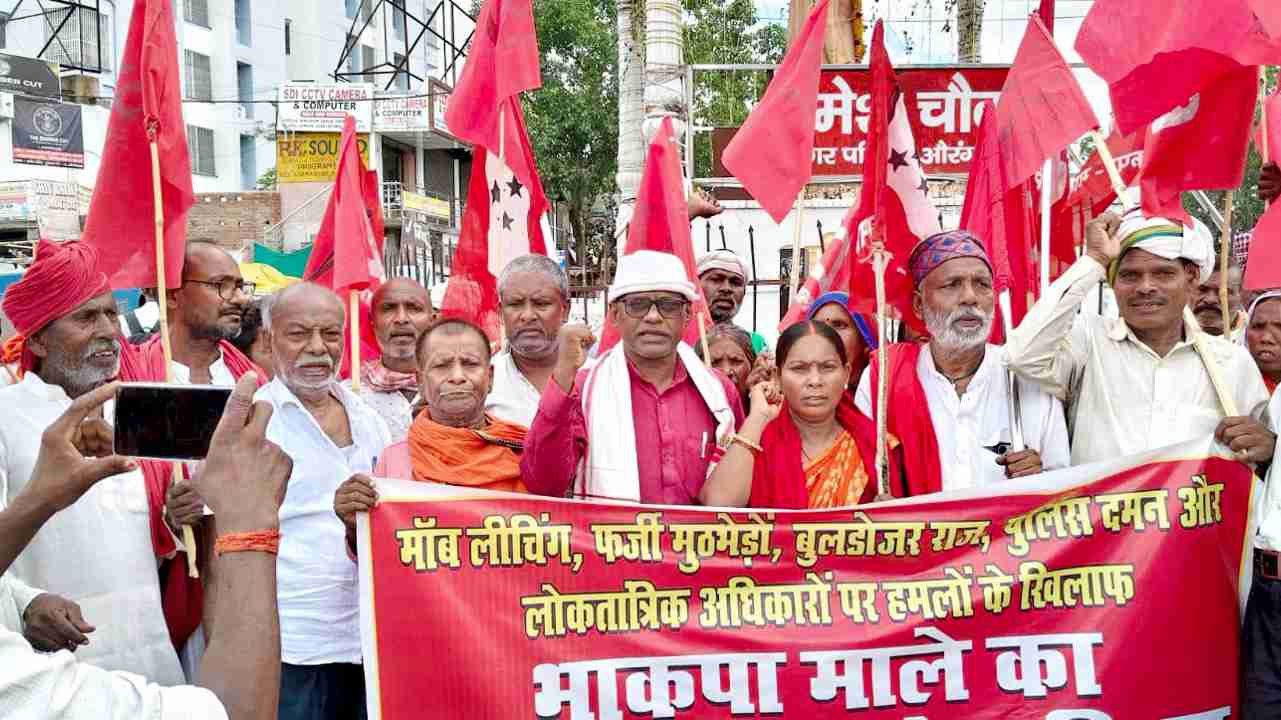
These developments prove that Bihar is gradually drifting away from the slogan of Sushasan (good governance) towards a ‘police state’ and ‘bulldozer rule’. Dipankar Bhattacharya, General Secretary of the Communist Party of India (Marxist-Leninist) Liberation, has argued that the foremost challenge today is to protect the rule of law. According to him, the government seeks to govern through fear while sidelining both the judiciary and the Constitution.
It is important to recognize that this is not merely a question of law and order. The real objective is to weaken the unity of backward classes, Dalits, and minorities—a coalition that, after decades of struggle, had displaced feudal forces from positions of power. Under the pretext of fighting crime, an attempt is being made to restore the old social order under a new political guise. Unless those who believe in social justice and democracy unite, it will become increasingly difficult to prevent Bihar from turning into an ‘encounter state’. The unfinished struggle for equality must once again be carried forward collectively—from the streets to Parliament.