
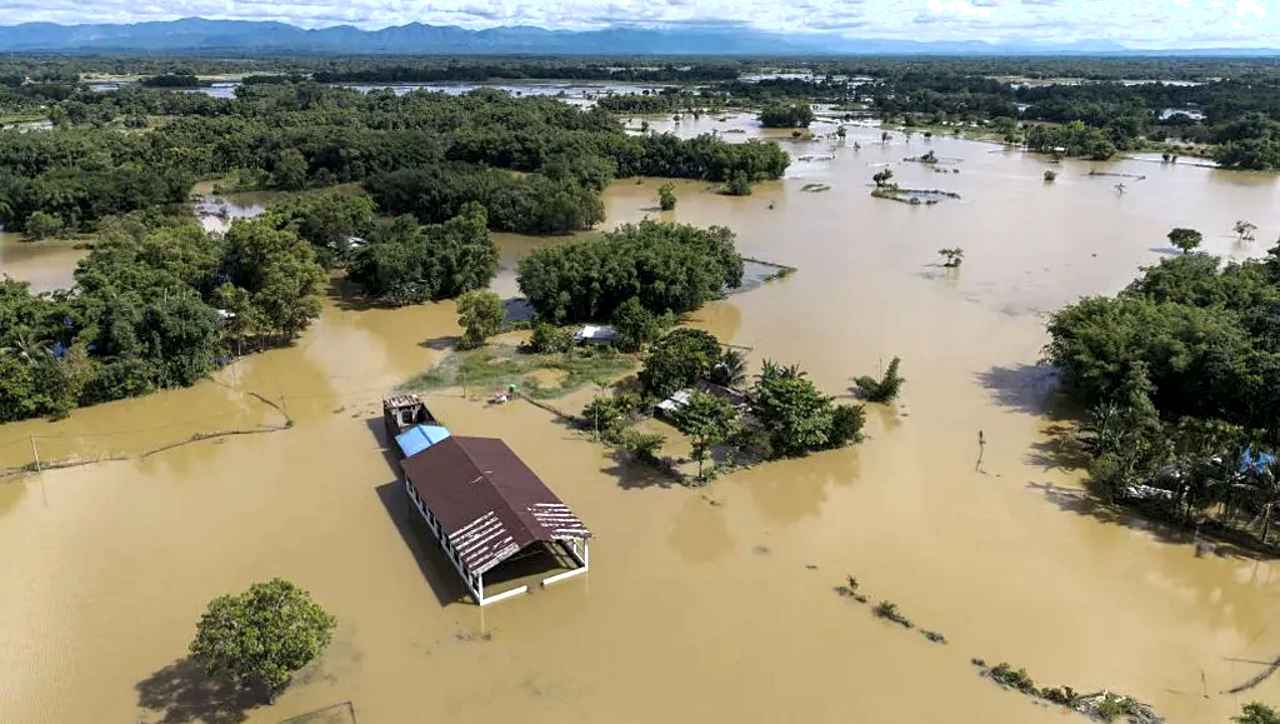
Nor can this disaster be regarded as a continuation of the floods that hit Sivasagar in 1981, nor can it simply be attributed to the widely circulated claim of a “cloudburst”. The India Meteorological Department (IMD) has clearly stated that the rainfall recorded in Mon district of Nagaland on 18-19 July did not meet the official criterion for a cloudburst, which requires at least 100 millimetres of rainfall within an hour over an area of 20-25 square kilometres. It is true that the rainfall during those two days was far above normal, but it did not qualify as a cloudburst.
This naturally raises an important question: if not a cloudburst, what caused such extensive devastation?
There is now a broad consensus that rampant illegal coal mining, illegal stone quarrying, illegal earth excavation and widespread deforestation together created the conditions for this disaster. In that sense, what Sivasagar has witnessed is not merely a natural calamity but a human-induced disaster.
Sivsagar and Charaideu Districts of Assam are situated sharing the bordering Mon district of Nagaland. The Dikhow -main rivers of Sivsagar district- originates in the Mon district of Nagaland flows through the entire Sivsagar district. The other rivers viz. Jaji and Bhogdai also come from Mon district of Nagaland and flows through Jorhat and Sivasagar. The havoc was caused by all three rivers but mainly by Dikhow. Coal fields are situated in Mon district and stone deposition takes place across the border of the both districts.
How have these illegal mining activities continued unchecked? Who is carrying them out? Under whose patronage are they operating? These questions are now being widely debated. It has become a matter of public discussion that several legislators belonging to the ruling party are allegedly involved in the coal and stone businesses.
What many people may not know is that the coal trade in the Naga Hills has today become even more profitable than the diamond trade. But how?
Mon district of Nagaland possesses abundant coal reserves. However, the Central Government has not granted formal approval for commercial coal mining there. Furthermore, Nagaland enjoys special constitutional protection under Article 371(A), so the ownership and control of its natural resources rest primarily with its indigenous communities. In other words, commercial extraction of coal is not legally permitted under the existing framework.
However, the Nagaland Government has permitted only limited rat-hole mining within an area of two hectares. Reports now indicate that vast illegal open-cast mines, resembling artificial lakes, have been excavated instead.
Who is carrying out these operations? Since the coal is ultimately used for commercial purposes in Assam and other states, it is evident that enormous quantities of coal are being transported out of Mon district. It is also widely acknowledged that Mon district remains under the effective influence of the NSCN. Therefore, it is difficult to imagine that such large-scale mining could take place without its knowledge or consent.
This naturally raises another question: are certain coal traders from Assam taking advantage of the relatively weak administration in Mon district by paying taxes or levies to the NSCN?
It is important to note that neither the Government of Assam nor the Government of Nagaland receives any royalty from this coal, because, legally speaking, commercial coal mining is not authorised there. It therefore follows that the coal business operating in the Sonari, a bordering area (assembly constituency) of Assam is most likely supplied from Mon district. The Government must clearly tell the people whether this coal trade is legal or illegal. It must also clarify whether the coal business allegedly associated with the BJP MLA of Sonari is lawful or unlawful.
Even if the people of Assam are unaware of it, the residents of Nazira know that the present MLA of the Nazira constituency is associated with the stone business. It is for reader's information that under the Sivasagar Forest Division (Assam) there is an independent forest beat known as Bihubar Beat, located within the Nazira constituency is famous for stone reserves. Readers may be surprised to know that securing a posting as the officer in charge of this beat requires paying bribes exceeding one crore rupees to higher authorities. Such allegations themselves indicate the enormous money-value attached to this forest beat.
The Dikhow River carries large quantities of stones from the upper reaches of the Naga Hills, depositing them in the Bihubar and Chantak area. Consequently, this region has evolved into a major centre of the stone trade. Ironically, the recent disaster almost wiped out both the Bihubar and Chantak areas.
Before the construction of the four-lane highway across Upper Assam, the Forest Department had reportedly informed the Government of Assam that there would not be sufficient earth available for the project. Subsequently, several lakh cubic metres of earth were excavated from the Naga Hills and used in the construction of the highway.
Satellite data reveal that between 2001 and 2025, Mon district lost approximately 55,000 hectares of tree cover, the highest among all districts in the state. In addition, several instances of illegal encroachment on forest land have been officially documented. One such example is the 2,138 hectare Lokhipahar (Jaboka) Forest in Tizit, where large tracts of forest have allegedly been encroached upon and converted into private plantations.
What we have witnessed in Sivsagar is only a glimpse of the devastating consequences of the model of development pursued under the BJP.
The destruction caused in Sivasagar and Charaideo is multi-layered with far-reaching repercussions. Houses have been washed away, agricultural fields have been buried under sand and silt, and many fertile areas are likely to become covered with stones, rendered uncultivable. Families have lost all their identity documents and official records.
People may be able to arrange food and clothing for the victims for a few days through public support, but the enormous infrastructural and long-term challenges created by this disaster cannot be addressed by anyone other than the Government itself.
Unfortunately, the Government of Assam has failed to display the empathy and responsibility expected in the aftermath of such a catastrophe. A government that claims to represent the very flesh and blood of Assam's indigenous people has shown little concern or compassion at a time when one of Assam's most historic and culturally significant regions has suffered unprecedented devastation. During India's freedom struggle, when the movement for independence had gathered tremendous momentum, the RSS found little opportunity to expand its politics of hatred. K. B. Hedgewar wrote:
“As a result of Mahatma Gandhi's Non-Cooperation Movement, the nation's enthusiasm (for Hindu nationalism) had cooled down, and the social evils unleashed by that movement had raised their heads in a frightening manner. Nourished by the milk of the Non-Cooperation Movement, the Yavana snakes began hissing venomously, inciting the nation towards conflict.”
Today, the people of Assam are increasingly convinced that the Sivasagar disaster is not merely a natural calamity but one created by a nexus of government-backed mafias and illegal extractive activities. At a time when Hindus and Muslims stood shoulder to shoulder, rescuing one another; when leaders whom the Chief Minister has often portrayed as political adversaries, such as Badruddin Ajmal and Mahbubul Hoque, came forward in a spirit of humanity to assist the victims; and when Akhil Gogoi and other social political activists devoted themselves day and night to the service of the flood-affected people, Chief Minister Himanta Biswa Sarma and his administration appeared ineffective and conspicuously absent.
Just as the Pulwama tragedy was, in the eyes of many critics, politically exploited instead of focusing solely on bringing the perpetrators to justice, there is now a growing perception that the Government is attempting to derive political advantage from this disaster as well, rather than addressing its root causes and the suffering of the affected people.
The real image of the Chief Minister's sense of responsibility became exposed when he reportedly remarked: “I received the information from the Chief Minister of Nagaland within ten minutes. But what could I have done?” This statement raises serious questions about disaster preparedness and administrative accountability. Disaster management agencies routinely issue alerts warning of approaching storms, heavy rainfall and other emergencies. Had the Chief Minister immediately issued a high alert to the Deputy Commissioners of Jorhat, Sivasagar and Charaideo after receiving the information, I firmly believe that nearly seventy per cent of those who lost their lives might have been saved.
The words of the great social reformer Srimanta Sankardev remain profoundly relevant even today:
“Famine shall strike the land, and the people shall perish for want of food;
The rulers, in pursuit of revenue, shall continue to oppress their subjects.”
May this prophetic warning not become our reality once again. The Government must provide relief and rehabilitation to the flood-affected families in equal proportion to the losses they have suffered. While food and clothing may be arranged temporarily through public support, long-term rehabilitation requires decisive governmental intervention. Every affected family should be granted a comprehensive relief package, including a waiver of outstanding loans and immediate financial assistance of at least ₹1 million (ten lakh rupees) for rebuilding homes, replacing educational materials, and restoring other essential belongings.
A government that can extend tax concessions and financial incentives worth thousands of crores of rupees to large corporate houses should not hesitate to announce similar relief measures for the people of Assam who have lost everything in this unprecedented disaster.
Finally, the entire issue of illegal coal mining must be investigated through a judicial inquiry headed by a sitting Judge of a High Court. Illegal coal mining, illegal stone quarrying, and all forms of unlawful extraction of natural resources must be halted immediately. No society can allow the reckless pursuit of profit by a handful of individuals to endanger the lives, livelihoods and property of millions. Those responsible for this human tragedy must be identified, held accountable, and brought before the law.
Only by ensuring transparency, accountability and justice can such disasters be prevented from recurring, and only then can the people of Assam regain confidence that their lives and environment are valued above the greed of a privileged few.