Mainstream newspapers and television channels had portrayed the incident as ‘a violent clash between two rival groups involved in the illegal sand-mining business’. However, that version bore little resemblance to reality. The truth was the exact opposite of what had been presented through television cameras and newspaper headlines.
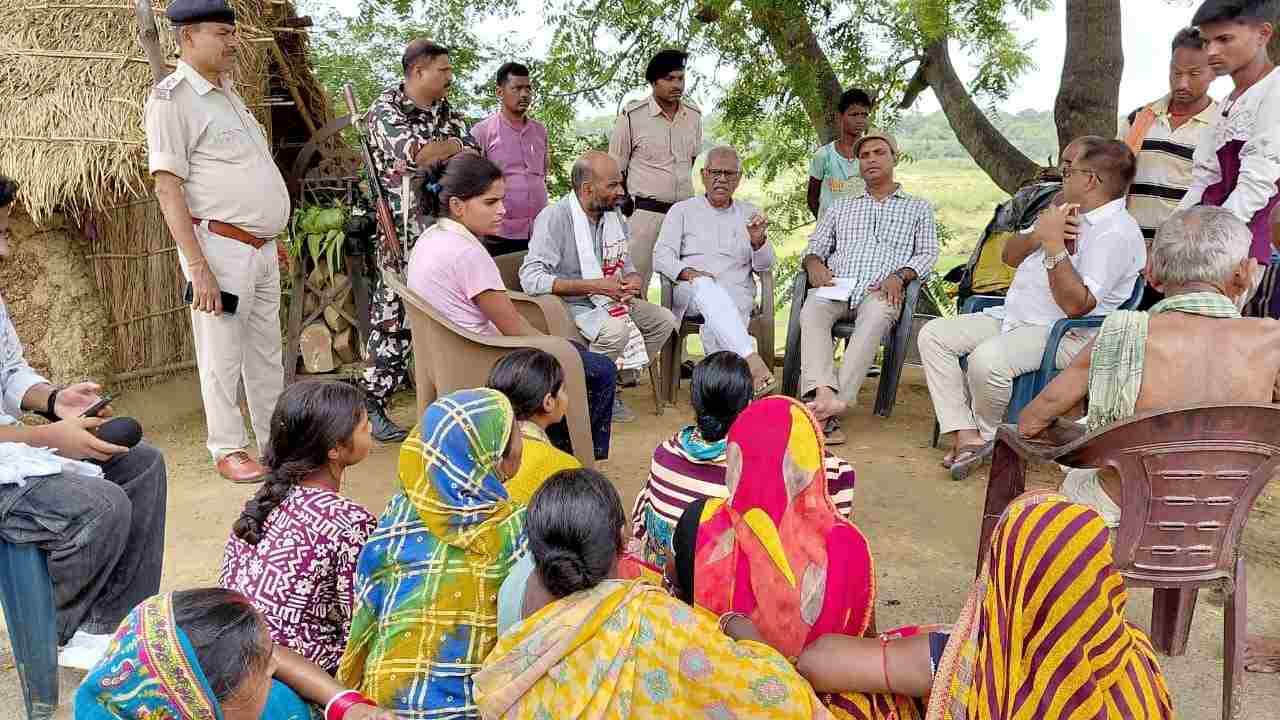
As we entered the village, we first encountered a group of men. They immediately recognized our delegation leader, Comrade Mahanand Singh, former MLA from Arwal. Rather than fear, their faces reflected shared grief, resilience, and determination. After exchanging greetings of ‘Lal Salaam’, we began discussing the events of the morning of 4 July, and gradually the layers of the story unfolded. Walking further into the village, we reached the very spot where the firing had taken place four days earlier. A group of women stood there, accompanied by several school-going girls. Sitting with them on the ground, we began reconstructing the events of that terrible morning.
Chaiti Pipar is a small settlement consisting of approximately 100 Ravidas households, 10 Ramani households, and three Yadav households, inhabited primarily by economically disadvantaged families. Although the government has officially prohibited sand mining in the Falgu River, the villagers alleged that Vishnu Sharma, also known as ‘Vishnu Don’, a resident of the neighbouring village of Ghinji, had continued illegal sand extraction round the clock under the open protection of the local police stations of Ghosi and Hulasganj. According to the villagers, his influence was so overwhelming that merely approaching the river could invite deadly consequences.
Among those living there under conditions of poverty and feudal oppression was Runi Devi. On the morning of 4 July, she made a simple but important request to her husband, Vijay Ram (also known as Vijay Choudhary). "Our daughters are growing up" she told him. "We need to protect them from the indecent gaze of society. We must build a toilet at home. Please go and bring back one or two sacks of sand from the river". Contrast the government's expensive campaign promoting India as ‘Open Defecation Free (ODF)’ with the harsh reality where Dalit women in many villages are still forced to relieve themselves in the open, exposing them to harassment and intimidation by the criminals of the sand mafia gang.
When Vijay Ram approached the river to collect sand for constructing the toilet, he was confronted by armed men working for Vishnu Don. They threatened him, saying that “if he dared to touch the sand, there would be corpses on the ground”. Instead of retreating, the villagers protested what they regarded as an unjust assertion of control over a public resource. A heated argument followed, which eventually subsided. At that moment, the confrontation appeared to have ended but that was a temporary calm before the upcoming storm. Approximately an hour later, criminals led by Vishnu Don returned, a large group of armed men carrying both firearms and traditional weapons. The attackers entered the Dalit settlement displaying rifles openly. The villagers said that this was not an ordinary assault but a carefully planned operation to execute a ‘planned massacre’ intended to silence and annihilate the entire settlement. Gunfire reverberated throughout the village. One bullet grazed Reshmi Devi's head, leaving her seriously injured. Ajay Ram was shot directly in the abdomen. Sudhir Ram suffered a gunshot wound in his leg. Within moments, five people lay bleeding on the ground.
The attackers then rounded up several men from the village and began dragging them away by force. Speaking with trembling lips but determined eyes, Kanchan, Sudhir Ram's sister, a student in Class XI described what she had witnessed from the rooftop of her house. She said that she and her sisters watched in horror as their brothers were shot and as bullets rained through the village. For a few moments, she admitted, fear overwhelmed her. But then, she said, an extraordinary courage emerged from within. Instead of hiding inside their homes or breaking down in tears, the women of Chaiti Pipar armed themselves with sticks and rushed directly to confront the attackers, unafraid of the bullets.
When the attackers attempted to carry away Dinesh Ram, whom they had already shot and intended to kill and mutilate, the women resisted. The unarmed women prevailed over the rifles and confronted the heavily armed goons, physically restraining them and freeing their captured husbands and relatives from the clutches of the attackers. The leader of the group, Vishnu Sharma (Vishnu Don) was held captive by them for nearly half an hour. Having little faith in the local police, they chose not to hand him over to the officers stationed nearby. Instead, they telephoned the senior administrative officials directly and surrendered him into their custody. During the counter offensive of the women, one of the goons, Dheeraj Sharma, was accidentally killed by gunfire from his own associates.
The exemplary courage displayed by the women remind us of the celebrated poem by the revolutionary Hindi poet Gorakh Pandey, originally written against feudal oppression in Kaitharkala, Bihar.
Oh! What happened? What happened?
They were as gentle as cows,
They appeared so helpless!
How did they snatch away the guns?
They confronted the sand-mafia gunmen,
Captured their leader and handed him over to the police,
Freed their men-
These are the women of Chaiti Pipar!
When our team later sat down with Kanchan, they found neither tears nor despair in her eyes. Instead, there was deep anger and a plethora of burning questions directed toward the state of affairs. Challenging the biased official narrative and the media, she said- “the administration and the media claim that this was a clash between two rival mafia groups. I ask them to come and look at our homes. Look at these broken huts. We cannot even afford enough sand to build a wall for our toilets. Do people like us possess guns and rifles? Why is the administration treating us like this? If we had firearms, would we have kept Vishnu Sharma alive for thirty minutes? Would we have handed him over alive to the police? We would have killed him ourselves. All we had were our sticks and the determination that, if we had to die, we would die fighting".
This incident has sharply divided the political opinion in Jehanabad district. Since the formation of the BJP-led government, feudal elements and the sand mafia have become increasingly emboldened. Some members of the Bhumihar community have attempted to portray this brazen criminal act of violence as a ‘caste conflict’. The conduct of Arun Singh, the father of the local MLA Rituraj Singh deserves special mention for its insensitivity. He visited the family of the deceased sand-mafia, Dheeraj Sharma, to offer condolences but did not visit the nearby Dalit settlement of Chaiti Pipar, where several people had been injured.
This incident has strengthened unity among the Chandravanshi community. Many of them now regret having voted for political representatives whom they believe have sided with the perpetrators of the violence. This attack has given rise to an unprecedented and rock-solid unity among the rural poor. Members of the Ravidas, Ramani and Yadav communities are now standing together in opposition to what they describe as terror and intimidation. The progressive elements of society refuse to accept the argument that the incident was a struggle between two caste groups. Rather, they believe that the fight is between the terror unleashed by the sand mafia and the resolve of the rural poor to fight back for their rights and self-respect. Even the state administration is fractured in their assessment of the incident.
Kanchan highlighted a particularly painful consequence of the atmosphere of terror- the education of village girls. She explains that the education of girls has effectively come to a halt because the only nearby secondary school is Ginji High School, and the route to the school now passes through an area they no longer consider safe. Her fear is a slap on the face of the system and raises the question whether the administration intends to provide any secure alternative for the girls' education or whether their future, too, will become another casualty of the mafia's reign of terror.
CPI(ML) responded quickly to the incident. Following a visit to the village on 5 July by the party’s district secretary Vijay Kumar, Ravindra Yadav, Prabhat Kumar, Indresh Paswan, Arun Bind and Sanjay Chandravanshi, a large protest march was organized in Ghosi on 6 July. The party activists declared that they would not allow feudal forces or organized mafia networks to regain influence in southern Bihar. A district-level protest march was held on 11 July 2026 in Jehanabad, in which the affected families and the brave women of Chaiti Pipar themselves participated and challenged the deaf administration. Later, on 20 July, a massive Chaiti Pipar Chalo march was organised at the village followed by a massive rally at Ghosi which was attended by thousands of people.
The struggle of Chaiti Pipar is not merely about access to sand. Rather, it is a manifestation of a broader struggle against the plunder of natural resources, feudal domination, and the nexus between criminal networks and sections of the state machinery. At its heart, lies the fight of society's poorest citizens for dignity, identity and fundamental rights. The oppressors seem to have forgotten that whenever Bihar was subjected to oppression, it turned the tide of history. This time, the onus for writing that history has been assumed not by men, but by the courageous women of Chaiti Pipar.
Salute to the historic resistance of the women of Chaiti Pipar!
Red Salute to their courage and revolutionary spirit!