Yet again, minimum wages becomes a much contested issue.
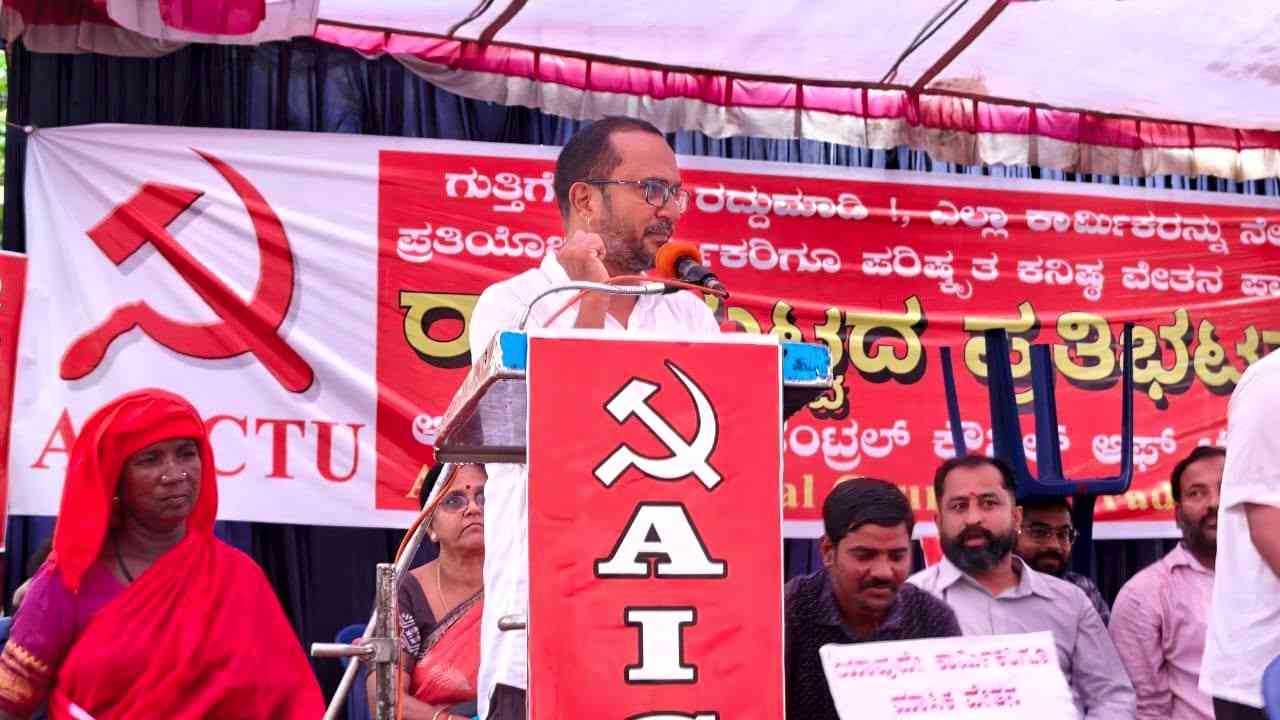
Memory is inexplicable. We simply forget. Barely a few months ago, lakhs of workers across the industrial belts of Haryana, Delhi and western Uttar Pradesh poured out of factories and workplaces and occupied the streets, demanding something that ought never to have required a struggle in the first place, the right to earn enough to live with dignity. Thousands of workers from hundreds of factories halted production and asserted, collectively, that wages frozen in the face of relentless inflation had become wages of destitution. Their demands were neither extravagant nor revolutionary. They asked for wages that could keep pace with soaring food prices, spiralling rents, escalating transport costs and cooking gas prices that had surged in the wake of the conflict in West Asia. Their demand was, in essence, the demand to survive.
The response of the State was revealing. Instead of recognising that the protests were a desperate assertion of the constitutional promise of dignity, it resorted to repression. Thousands faced FIRs, arrests and detention. Trade union activists were hunted down. The draconian National Security Act was invoked against labour organisers. The familiar script unfolded once again. A dispute over wages was recast as a law-and-order problem and collective bargaining was treated as criminal conspiracy.
Yet, despite the repression, the workers won. Both, the Haryana and Uttar Pradesh Governments were forced to enhance minimum wages. Governments that had, until then, maintained that the existing wage structure was adequate, conceded what workers had been saying all along, that the prevailing minimum wages had ceased to bear any relationship to the actual cost of living.
While these struggles were unfolding in North India, Karnataka was completing a process of minimum wage revision that had been pending for nearly a decade. In April 2025, the State Government issued a draft notification revising minimum wages. The delay itself is telling. For almost nine years, wages remained substantially stagnant while inflation relentlessly marched ahead. The price of food increased. Housing became more expensive. Public transport costs rose. School fees escalated. Healthcare became prohibitively costly. Electricity tariffs climbed. Every component of a worker's monthly expenditure expanded, while wages remained trapped in a different economic era. Even the revised wages, are not a windfall as being projected; it is, at best, a partial correction of years of erosion in the purchasing power of wages. In fact Unions, applying the principles mandated by the Supreme Court in its 1992 Reptakos judgment, have projected that the bare minimum wages today would be around Rs. 42,000/-.
Yet, management lobbies, by mis-projecting that this wage hike is unprecedented has resorted to the normal bogies. Karnataka, they argue, would become "uncompetitive". Industries would relocate to neighbouring States. Investment would dry up. Employment would suffer. The same arguments that resurface with ritualistic regularity every time minimum wages is revised.
Previously in 2017, when the minimum wages were last revised in Karnataka, management lobbies raised a furore that the wages were hiked by 75% and followed the exact same playbook and arguments. A Division Bench of the Karnataka High Court comprehensively rejected the managements’ challenge to the wage revision. Pertinently, the then State government, bowing to “pressure” from the garment industry lobby, withdrew in March 2018, three of these final notifications - Textile (Silk), Spinning Mills and Cloth Dyeing dated 30.12.2017. This was challenged by one of the Unions in the Karnataka High Court, culminating in the judgment of the Division Bench striking down the withdrawal as illegal and restored the final notifications. The Division Court specifically held that once the final notification was issued the State Government does not have the power to withdraw the same under the guise of review and revision, and further that, the moment the final notification was issued, a vested right was created in the employees to get wages as per the said final notification and the same could not be taken away through any such withdrawal. These ought to have been lessons learnt for the State Government.
In this context, the mythology of "industry flight" deserves closer scrutiny. In 2017, the managements claimed that the 75% minimum wage hike would sound the death knell for the industry in Karnataka, as they do now even though the hike is comparatively a modest 20%-30%. Capital has never moved solely because wages increased. Investment follows infrastructure, stable governance, skilled labour, efficient logistics, reliable electricity, access to ports and markets, institutional certainty and the size of the consumer economy. If cheap labour alone determined industrial location, the poorest districts of India would today be its manufacturing powerhouses. They are not. The repeated invocation of industry flight therefore serves a different political purpose, which is to transform workers’ rights into a privilege contingent upon the consent of capital.
There is, however, a deeper question that is carefully avoided. If industries threaten to leave every time workers demand wages sufficient to sustain life, what exactly is the model of development being defended? Is Karnataka expected to compete with other States by ensuring that its workers remain perpetually underpaid? Is the comparative advantage of the State to be built upon the inability of workers to educate their children, obtain healthcare or secure decent housing? If the viability of an industry depends upon paying wages that do not permit the worker to live with dignity, it is not the wage that is economically irrational, it is the business model.
The debate over minimum wages has never really been about economics alone, and has always been about power. The law on minimum wages emerged because Parliament recognised that the bargaining power between employer and employee is fundamentally unequal. A hungry worker with unemployment staring her in her face, does not negotiate freely. Left entirely to the vagaries of the market, wages gravitate not towards justice but towards desperation. The law therefore intervenes not to distort the market, but to correct an inequality that the market itself creates. Interestingly Ambedkar had this to say, which has sage relevance: “In an economic system employing armies of workers, producing goods en masse at regular intervals some one must make rules so that workers will work and the wheels of industry run on. If the State does not do it the private employer will. Life otherwise will become impossible. In other words what is called liberty from the control of the State is another name for the dictatorship of the private employer.”
For ten years since 2017, minimum wages were not revised, and managements paid the unrevised wages and nothing more. For nearly a decade, workers silently absorbed the costs of inflation and subsidised industry by accepting wages that steadily lost their purchasing power. Yet the moment the law attempts a modest correction, the discourse abruptly shifts to the hardships of employers.
Perhaps that is why memory is political. We remember threats of industry flight, but forget years of wage stagnation. We remember the inconvenience caused by workers' protests, but forget the desperation that made those protests inevitable. We remember balance sheets, but not empty kitchens. And in forgetting, we permit the same argument to return every decade as though demanding a wage sufficient to live has somehow become an unreasonable demand. As such, the real question before us is not whether industry can afford to pay workers more; it is whether a constitutional democracy can continue to tolerate an economy in which those who create society's wealth are expected to remain permanently on the edge of poverty so that others may continue to accumulate it. To rephrase, the real question is not whether industries can afford to pay workers a little more, but whether workers can afford to continue living on wages that no longer cover rent, food, transport, education and healthcare. This is the question that the Karnataka State Government has to answer now.