
Liberation spoke with Sarah Bretschko, social scientist at ICTA, Autonomous University of Barcelona, and an environmental and urban neighbourhood organiser based in Barcelona, Spain about the economic conditions behind the protests, the organisation of the movement, its demands and the possibilities for a broader working-class struggle.
The protests drew international attention after the eviction of 87-year-old Maricarmen Abascal in Madrid, who has since died. But evictions have been happening in Spain for many years. What explains the eruption of the movement at this particular moment?
Sarah Bretschko: First of all, it’s actually not a single eviction. What has been reported in international media is the eviction of Maricarmen in Madrid on 23 September. But a few weeks prior to that, a 54-year-old woman, Olga, who lived in L’Hospitalet de Llobregat in the suburbs of Barcelona, took her own life after having been evicted from her home. It’s a less pretty case, because she was a much poorer woman. She left behind two kids. Within the movement in Spain, her death was another key trigger for why the protests kicked off as strongly as they have.
These evictions, although they might be portrayed as extreme cases in international media, are actually something that happens every week. In each city in Spain, and more so in the bigger cities, the housing syndicate calls for protests to prevent evictions practically every single week. The eviction of Maricarmen and the death of Olga were the drop that caused an already extremely explosive issue to boil over.
The material conditions are key to understanding this. Rents have been rising enormously over the last five to ten years, while there has been a complete stagnation of salaries for the working classes in Spain basically since the turn of the century. The segment of the working class that depends on renting because it doesn’t have access to buying flats is in an extremely precarious situation. Renter protection is very, very weak in Spain, and people don’t have the possibility to find new rental contracts when their contracts run out.
All of this comes in combination with rising costs of living in general, with a very racist rental market where people who aren’t from a Spanish background are discriminated against a lot, and with tourism, which causes the proliferation of short-term rental contracts and the removal of apartments from the market. But at the heart of it is this extreme increase in rents and the stagnation of salaries, in a very neoliberalised housing market.
How would you describe the organisation and participation of the movement? Is it primarily organised through housing syndicates (tenants’ unions), or are trade unions, students and political organisations also participating?
I would say the backbone of the movement is the renters’ union, the Sindicat de Llogateres, as it’s called in Catalan. It is organised in neighbourhood sections, or town sections in smaller places, with umbrella organisations that usually work regionally. The strongest ones are in Barcelona and Madrid.
These organisations have been active for many years. At the neighbourhood level, they focus on supporting people who are in precarious situations because of the housing market. They try to prevent evictions, find new places to live for people who are evicted, and help you if you have problems with your landlord.
But the umbrella organisations have been very active in recent years in politicising housing. They replaced a narrative that said the problem is too little supply for too much demand with one that says this is actually a class struggle. The problem is a neoliberalised housing market where housing is treated as an asset, with a flood of international speculative investment funds buying up housing and speculating with it. That has been a very strong contribution by the movement.
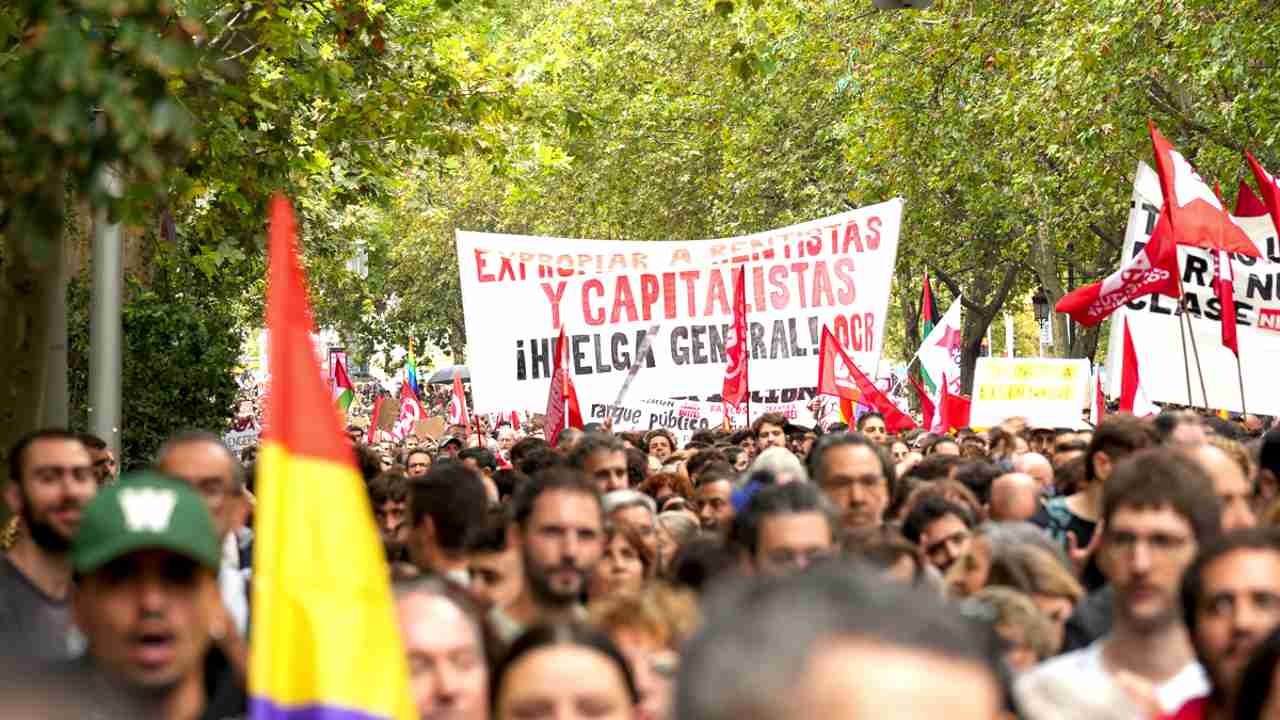
What makes the movement stronger right now is that it has reached a scale where other movements and organised groups are starting to collaborate in this struggle. There will be a general strike on 11 November. There has been dialogue between the main unions and the housing syndicate before, but this is the first actual material collaboration where all the major trade unions are on board. The feminist movement, the anti-racist movement and the ecological movement are now also organising to support the housing struggle.
The general strike is still a few weeks away. How is the movement building towards it?
Sarah Bretschko: In the weeks after the protests broke out following Maricarmen’s eviction, protest camps were set up in Madrid and Barcelona, and they are still ongoing.
Since the strike was called, strike committees have been forming, usually at the level of each neighbourhood and also at the level of sectors. So the teachers’ union has its strike committee, but your neighbourhood also has a strike committee. These groups have started to meet weekly, and I suppose that in the week leading up to the strike they will meet even more often. They are organising what the strike will look like in their specific neighbourhood and mobilising more people, for example bringing on board small shops and other business owners.
The renters’ syndicate has experience with this. In the past it has gone door to door to mobilise for demonstrations and, more importantly, for rent strikes in buildings that were supposed to be evicted. So now there is a big effort to get more people on board who aren’t already involved in the housing struggle. I can only speak for Barcelona from personal experience, but the neighbourhood strike committees are really well attended. There are around a hundred people from each neighbourhood coming to the committees, and then they report back to their groups. It seems quite powerful at this point.
What are the immediate demands of the movement, and how does the political situation in Spain under Pedro Sánchez’s government affect the prospects of achieving them?
There is a list of demands that the housing syndicate has communicated, which can basically be summarised in the new decree that is supposed to be passed at the national level. A new housing decree was supposed to be passed in the week after Maricarmen’s eviction, but it was voted down by Vox, the far-right party [along with the PP and Junts]. So right now there is no significant change in the housing law. And the strike will take place around three weeks before the elections that Sánchez called after this fallout. Housing will be the central issue of these elections, so that timing is also in play.
Sánchez’s party is basically so-called social democratic. He is very good discursively and likes to position himself broadly in line with what many left movements have been struggling for in recent years, also on Palestine, for example. But it’s a discursive move. Everyone in Spain understands that Sánchez is not actually a socialist, as he sometimes gets portrayed in international media.
On the one hand, having such a strong movement at a moment of elections where housing is the central issue is an opportunity. With Sánchez in power, there is a chance that this decree actually gets passed and that there is some legal change in terms of renters’ law and protection. But it’s not a given. If there is not enough pressure from the streets, it is very easy for Sánchez to just say, okay, I will pass a watered-down version of this decree, and that’s it. So in some way the situation is favourable for the movement, because the ruling party is not completely opposed to it. But it’s also not that we actually have a left government, or a government that’s far from the political centre.
Suppose the legislation does go through. Do you expect a gap between the law on paper and its implementation on the ground?
Again, I think it will depend a lot on pressure from the streets. If the whole list of demands that the housing syndicate is propagating gets passed, that would be quite a move, because it includes, for example, a 50% reduction in rents, which is quite radical. One of the strengths of the housing syndicate is that it is really informed on the legal situation and very accustomed to helping people who have struggles with their landlords. So if the legal situation changes, the movement is already in a good position to keep pushing for these changes to actually be carried through.
The big discursive move has been situating the housing struggle as a working-class struggle. A strength of the strike on 11 November is that it brings together housing rights with workers’ rights; some of the demands also have to do with salaries. The question is to what extent we can keep pushing the demands. In the long term, the demand has to be to expropriate landlords, and not just to force them to lower rents. In Spain the housing market is almost entirely privatised. There is some public housing, but it is very limited, so this is a really progressive demand in a country without even a tradition of public housing. But the housing movement as it stands is in a good position to keep pushing in this direction.
====
Housing Crisis and the Demands of Tenants’ Unions
1. REDUCTION IN RENTAL PRICES
Rental prices cannot be left to the market to determine. Therefore, the rental price reference index must be reformed and linked to wages.
2. BAN ON EVICTIONS WITHOUT ALTERNATIVE HOUSING AND INDEFINITE LEASE AGREEMENTS
Minimum conditions for residential stability must be guaranteed as a prerequisite for material security. To this end, we demand a ban on all evictions involving vulnerable individuals who lack alternative housing, and that rental agreements be made indefinite.
3. EXPROPRIATION OF HOUSING OWNED BY BANKS AND VULTURE FUNDS
Housing held by major speculators must be reclaimed and placed under public control; furthermore, speculative purchases must be prohibited to prevent the hoarding of properties.
4. DEVELOPMENT OF A PUBLIC HOUSING STOCK
A genuine public housing stock must be built, financed through a special tax on rent-seeking (income derived from property ownership). It must also be made entirely public, removing minimum income thresholds for access.
5. RECOGNITION OF TRADE UNION RIGHTS
Rights must be guaranteed through the self-organization of workers. Consequently, trade union rights must be recognized within the housing sector—including the right to collective bargaining, union representation, and rent strikes in instances where property owners fail to meet their obligations.
6. INCREASE OF THE INTERPROFESSIONAL MINIMUM WAGE (SMI) TO €1,600, AND A MINIMUM PENSION EQUAL TO THE SMI. The minimum wage must guarantee decent living conditions. Currently, it does not.
7. REDUCTION OF THE WORKWEEK TO 35 HOURS—WITH THE PROVISION THAT COLLECTIVE BARGAINING AGREEMENTS MAY ALWAYS NEGOTIATE A FURTHER REDUCTION.
Reducing working hours means sharing the workload and combating unemployment, while improving health, quality of life, and work-life balance.
8. WAGE INCREASES TO ADDRESS THE ACTUAL LOSS OF PURCHASING POWER.
For a very large segment of the working population, rent or mortgage payments consume between 40% and 60% of their income; however, this is insufficiently weighted in the Consumer Price Index (CPI), creating a discrepancy between official inflation figures and the real cost of living.
9. DEFENCE OF ALL PUBLIC SERVICES.