I. The fiction of Atmanirbharta
Modi spoke at length about Atmanirbharta, on building domestic production capacity and expanding exports. Following Trump tariffs and the large shock that cost India's textiles, fisheries, and exports overall, Modi has reverted to the rhetoric of Make in India and Atmanirbharta. The supposed idea is that India would reduce its import reliance by increasing production in India, by incentivising foreign companies to move their supply chains to India.
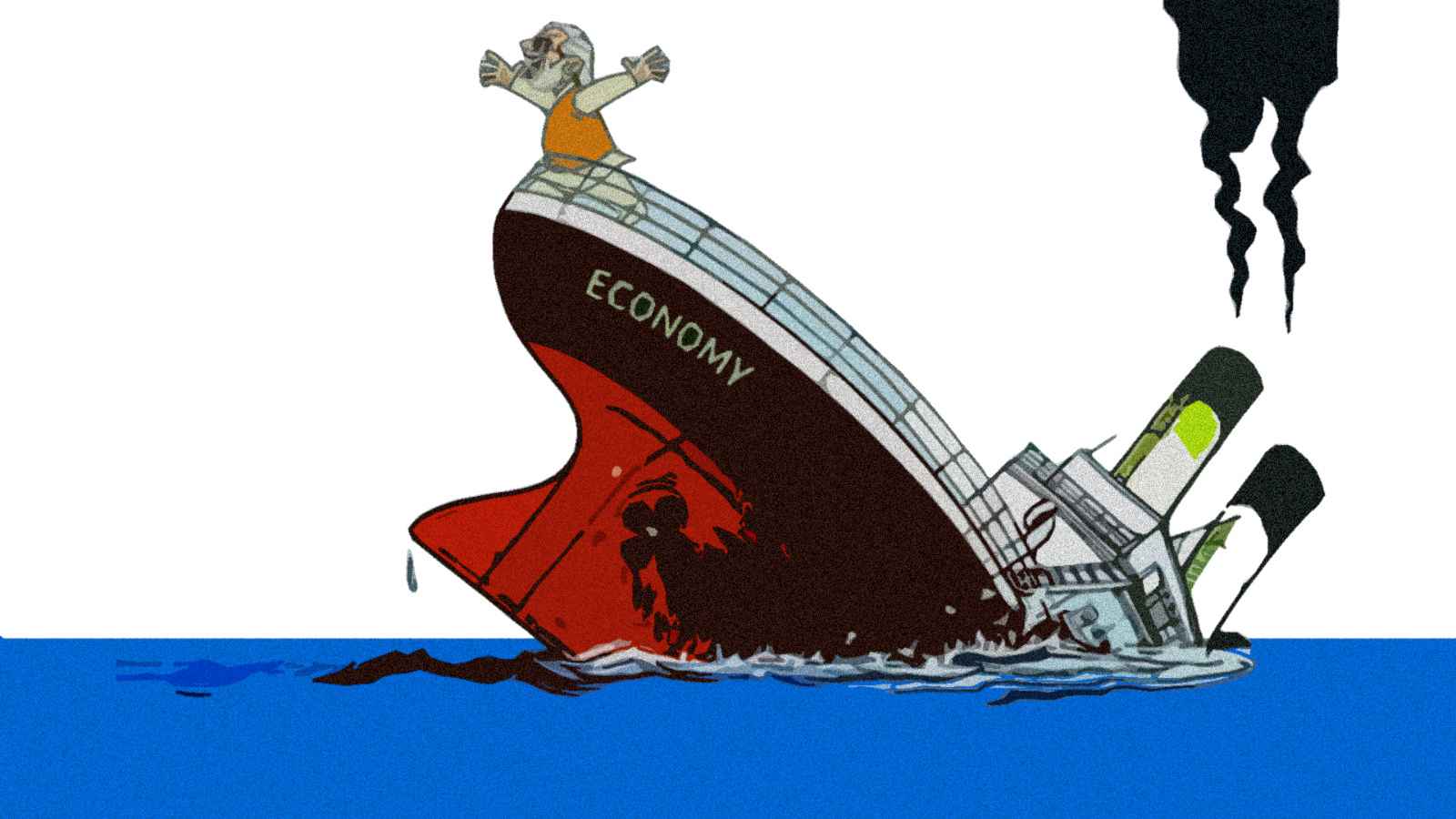
Central to this argument is Modi's repeated boast that his government has removed thousands of "compliances" and regulations in order to improve the ease of doing business, which means fewer safeguards for workers, consumers, communities and the environment from corporate malpractice. Yet the record of Foreign Direct Investment (FDI) provides little evidence of the promised investment boom. World Bank (WB) data put net FDI inflows at just 0.7% of Gross Domestic Product (GDP) in 2024—nearly 60% less than what it was when Modi took office in 2014. According to the Reserve Bank, net FDI collapsed to 0.01%—virtually zero—of GDP in 2024-25, the lowest in twenty-five years. Modi's treatment of the Indian economy has managed to make conditions worse for workers while simultaneously failing to produce the promised surge in foreign investment.
Modi attempts to mock his critics by arguing that globalisation has fallen out of the global lexicon in the past decade. However, the government's actions—boasting from the same ramparts of free trade agreements with almost 40 countries since 2014—hardly support his stated intent, because these trade deals make it cheaper for foreign producers to sell in Indian markets with limited concessions for Indian exports.
To supposedly boost Indian domestic production and exports, Modi lays out a seven-point strategy, what he calls "Saptadhara". Under manufacturing, Modi targets increasing manufacturing by reducing costs while simultaneously improving quality, and urges the country to change its "work culture". The only way this is remotely possible without research and innovation is through cutting wages and deregulating labour.
In agriculture and food processing, Modi says that farmers and producers alike must reform their "traditional systems", and that Indian agriculture must travel "from the field to the export market"—which likely means greater privatisation like what was tried with the farm laws.
Under technology and innovation, Modi talks about Made-in-India sixth-generation wireless technology (6G) reaching every corner of the country. Given Reliance Jio's dominant position in Indian telecommunications, will "Made in India" 6G translate into further public subsidies, rebates and state support for corporations such as Reliance Jio?
Under Gati Shakti, Modi talks about undertaking port-led development. In an economy in which the Adani Group has acquired an extraordinary position in ports and logistics, does state-supported "port-led development" mean public investment, land and infrastructure will further consolidate the position of corporations such as Adani?
Modi also boasts of the National Critical Minerals Mission and of the creation of a "critical mineral corridor" with agreements with foreign countries. In simple terms, villages and forests could be cleared to aggressively mine critical minerals which will be sold off to rich countries. He also boasts that 99% of India's coastline, once declared a "No Go Area", has been reopened as a "Go Ahead Area" for offshore exploration. This could destroy entire habitats and livelihoods over India's long coastline.
II. The fantasy of Viksit Bharat-by-2047
Narendra Modi made several tall claims about India's development goals and argued that progress since 2014 has been in line with India's aspirations of becoming a developed country, "Viksit", by 2047.
Modi claimed that 25 crore people had been lifted out of poverty over the last twelve years. The 25 crore figure comes from a NITI Aayog report covering 2013-14 to 2022-23 that has several problems. First, the Aayog changed the definition of poverty to measure multidimensional poverty—but not one of the 12 dimensions considered measures either income, employment, or consumption expenditure. Second, even for the variables considered, they were not measured for either the start year or the end year over which the claim is made.
Inequality is higher today in India than under colonial rule: the World Inequality Lab finds that 22.6% of national income went to the top 1% in 2022-23, the highest in its series since 1922, with the same 1% holding 40.1% of national wealth. However, even if we ignore inequality for a moment, for India to become a high-income country by 2047—a reasonable monetary definition for developed country—India would need to have a per capita income of around 22,000 dollars by 2047. Currently, India's per capita income is about 2,800 dollars.
This means that India would need an average per-capita growth rate of around 11% per year for the next 21 years when measured in dollars, as opposed to the current growth rate of around 5% per year since 2014. In the decade before 2014, India's nominal dollar GDP growth rate was indeed about 10–11%. When measured in rupees, the growth rate required would be about 15% per year, since the rupee has been depreciating relative to the dollar at about 4% per year under the Modi regime, with the dollar at around 95 rupees currently—it was 58 rupees when he took office. The rhetoric of Viksit Bharat is not matched by the growth trajectory required to achieve even a narrowly monetary definition of a developed economy.
But the Modi government does not seem to care about income, let alone education, healthcare, nutrition, etc. Instead, he misplaces his priorities on targets like how many Indian corporations make it to the Fortune 500 list—fifty, he proposes—how many big commercial banks make it to the top five global financiers, and how many big Indian pharma companies, law firms, rating agencies, consulting firms and accounting firms make it to the list of the world's biggest firms. These are measures of the scale and global position of Indian capital, not measures of the material welfare of the Indian population.
III. The reality of Corporate Takeover
Moreover, Modi makes claims about India achieving energy security—not primarily for giving people better access to electricity or clean cooking fuels, but for the production of semiconductors and operation of data centres. Modi now says India will produce 100 gigawatts (GW) nuclear energy capacity by 2047. India's current nuclear capacity is 8.78 GW, less than a tenth of the target. Even if India were to meet this fantastical target, where would all this uranium be mined? On whose land will this infrastructure and mining be built? Whose villages will be cleared? Whose homes will be demolished? Modi intends to expand private participation in nuclear energy production, while simultaneously proposing an enormous expansion of mining, energy infrastructure, data centres, ports and industrial corridors.
The common thread running through these proposals is a model of “development” in which the resources of the country—land, minerals, coasts, energy and labour—are increasingly reorganised around the requirements of large corporations. Atmanirbharta, on these terms, appears not as economic self-reliance for the Indian people, but as the construction of an internationally competitive Indian corporate sector through the transfer of public resources, ecological commons and labour into private accumulation. Under such misplaced priorities and fantastical assumptions, how will India become developed by 2047?