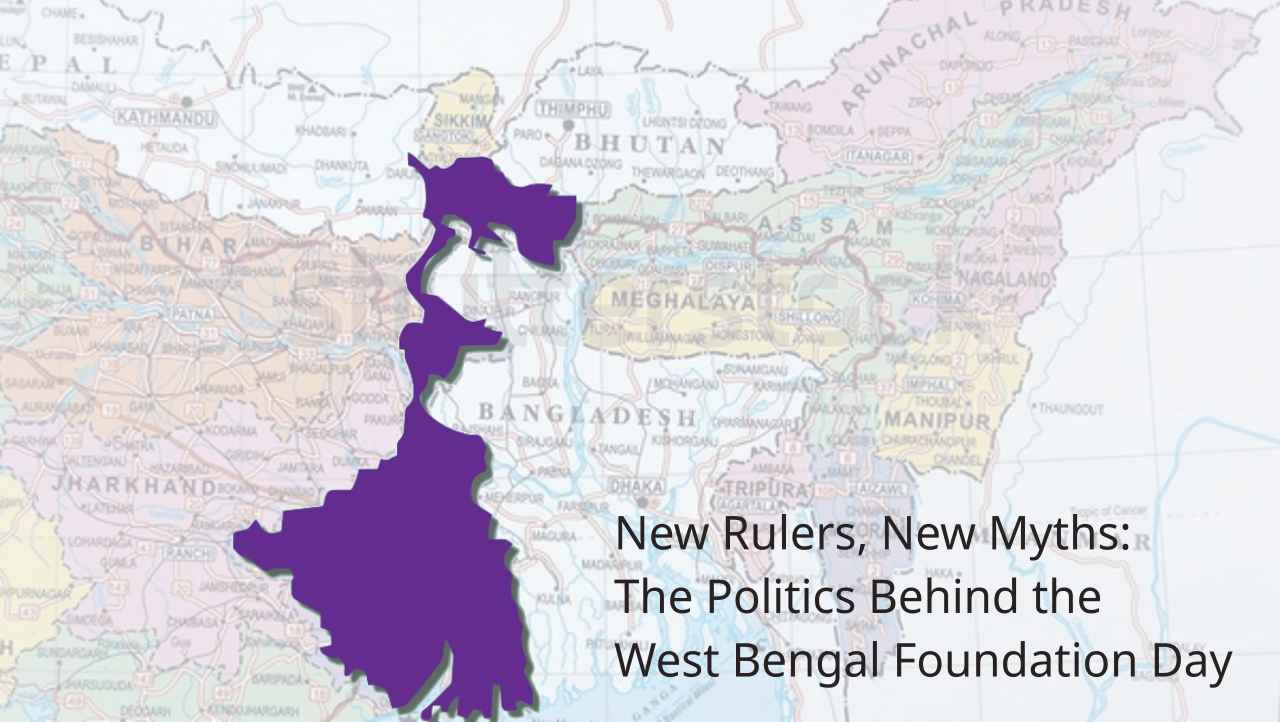
Maharashtra, Gujarat and Karnataka celebrate the days of their official creation as foundation days. The West Bengal Foundation Day marks an addition to this list, with a twist. A brain-child of the Bharatiya Janata Party (BJP), it not only celebrates the state’s creation but also adorns the state with a dangerous myth of power: that West Bengal is predominantly Bengali Hindu, and that this Bengali Hindu identity defines the state.
The ‘Two State’ Theory
In his column in The Telegraph, West Bengal’s finance minister Swapan Dasgupta has argued that the designation of the Foundation Day by his government is an act of historical recognition of the distinctiveness of West Bengal vis-à-vis Bangladesh. This recognition marks the start of a long-delayed confrontation with the trauma of partition by the people of West Bengal. Far from being an act of myth-making, this recognition in fact debunks the myth of a unified Bengali identity, mischievously perpetuated by the secularists, he suggests.
Dasgupta’s argument is strongly animated by the idea of a bipolar Bengali identity – the Bengali Hindu and the Bengali Muslim being the two poles. Within this framework, these two identities are understood to be seamless and distinctive, and often antagonistic. In the process, each becomes uniform and overwhelming in their own right, shaping the political, social and cultural lives on either side of the Indo-Bangladesh border.
The bipolar framework, as we all know, has a troubling past. Hindu / Muslim bipolarity was the key idea behind the ‘Two Nation Theory’. It laid the political and intellectual foundation for the Indian partition. However, as the enduring cultural diversity of Indian, Pakistan and Bangladesh show, the partition did not confirm the general acceptance or legitimacy of the ‘Two Nation Theory’.
Effected under extremely complicated circumstances involving multiple stakeholders, and legitimized through an election that was based on an extremely narrow franchise, the partition was decisive and irreversible. However, it was anything but an inevitable culmination of the purported Hindu/Muslim bipolarity. Millions of Muslims remained in India, and in West Bengal, by choice.
Though few Hindus remain in Pakistan and Bangladesh as compared to Muslims in India, heterogeneity and diversity are essential elements of all South Asian nations. Majoritarian governments of each of the post-partition states have had to go to great lengths to tear apart the composite culture of these societies. They have still not fully succeeded despite the violence that they have unleashed time and again.
The Left-Out Bengals
Proponents of uniformity tend to underestimate the essentially fluid and layered nature of identities. Any identity – be it Bengali, Bengali Hindu, Bengali Muslim, or Indian – is based on commonalities amidst differences and diversity. Dasgupta passionately argues about the existence of not one but two Bengals. In the process he ignores the fact that there aren’t two but many Bengals.
Besides a Hindu Bengal and a Muslim Bengal, there is a Dalit Bengal, an Adivasi Bengal, a Christian Bengal, a Buddhist Bengal, a rich man’s Bengal, a working-class Bengal, a resident Bengal, a migrant Bengal, and so on. Each of these Bengals cut across the Indo-Bangladesh border. Macro-identities such as Bengali Hindu, Bengali Muslim, Bengali and Indian are real too, but they are immersed within the many Bengals and do not stand apart from them.
The official 70 (Hindu)/27 (Muslim) statistic based on the 2011 census overshadows the many sects and denominations, castes, classes, and genders, that comprise these two blocs. The identities and interests of these smaller blocs converge on some issues and diverge on others. For instance, Dalits (23.51 percent) and Adivasis (5.8 percent) can hardly be straightjacketed as Hindus or Muslims without taking into account internal hierarchies within these religions. Besides a significant portion of West Bengal’s population are officially neither Hindu nor Muslim (nearly 12 lakhs, as per the 2011 census). Christians, Buddhists and other denominations may constitute a miniscule percentage of the state’s population, but that does not mean their enduring influence on Bengali culture should be either subsumed or swept aside by the Hindu/Muslim bipolar framework.
Bangladesh mirrors much of this diversity despite adopting Islam as state religion. According to the 2022 census, Bangladesh has nearly 1.5 crore Hindus, nearly 10 lakh Buddhists and 5 lakh Christians. Adopting a state religion hasn’t necessarily allowed Bangladesh to govern efficiently. The percentage of non-Muslims has steadily decreased in the country.
Whether Bangladesh laments this decrease or not, is beside the point here. For the better part of its history, Islam has been a key marker of East Pakistan / Bangladesh’s identity. India, in contrast, has always taken pride in its diversity and tolerance. There is no reason for that to change now, certainly not in Bengal.
Dasgupta’s punchline – ‘Indian Bengal and Bangladesh have commonalities but they are distinct’ – is a truism that no serious person has ever denied. Whether these two regions, or whether Hindus, Muslims, Dalits, Adivasis, Buddhists and Christians in West Bengal, are distinct or not, has never been the question. The question is how Indian governments should manage diversity and ensure that different communities pull together in one direction – towards the constitutional goals of justice, liberty, equality and fraternity.
A Fictive History
Dasgupta identifies three stages in West Bengal’s journey towards celebrating Hindu-ness: first came the long denial of Hindu-Muslim distinctiveness by the secularists, then the secularists lost legitimacy due to demographic transformations in Bengal, and finally West Bengal awakened to its distinctly Hindu identity by choosing the BJP over the secularists in the 2026 Assembly elections.
Hindu and Muslims distinctiveness are both organic and rooted in history. Contrary to Dasgupta’s accusation, no one has denied this through ‘intellectual acrobatics.’ Scholars and thinking people have only questioned whether bipolar frameworks can or should serve as general models for governing South Asia.
Bipolarity champions love to claim that they represent all members of their respective communities, like the BJP claims to represent all Hindus. They tend to deny the internal fractures within these blocks of identity, often to the detriment of those on the wrong sides of caste, class, and gender divides within those communities. Scholars and thinking people have questioned these claims and denials too, and rightly so.
The finance minister criticizes the so-called secular disavowal of ‘Muslim separatism’ in causing partition. People sensitive to the role of multiple stakeholders in the 1947 partition have never denied the role of ‘Muslim separatism’, they have just refused to singularize and exceptionalize its role. They have criticized one-sided and simplistic narratives that fan the fires of communal strife.
Contrary to his claims, the non-existent denial did not get exposed by the demographic transformation in Bengal’s border districts. That transformation exists more at the level of political discourse than at the level of ground realities. Between 2001 and 2011, when the census data were available, the share of the Muslim population in West Bengal’s border districts rose between 0.6 and 2.6 percentage points (pp) over the decade – nowhere near the whopping 40-pp figure mentioned in political speeches.
Secular political parties did not lose ground when their denial of Dasgupta’s fictive history was subsequently exposed by the turn of events. The Communist Party of India (Marxist) (CPIM) lost ground when its ill-executed industrial policies backfired, and different strands of anti-incumbency converged to ends its 34-year rule. Fifteen years after the CPIM lost West Bengal, the Trinamool Congress lost ground due to corruption, dynastic politics and the party’s deep-seated organizational weaknesses. Many people voted for the BJP expecting industrialization, employment generation, and better overall governance.
It must be stated here that the unified secular identity which Dasgupta projects onto a range of non-BJP parties is questionable too. Indian secularism has existed as a principle rather than as a prescribed set of laws or norms; its interpretations have swung between state intervention and deliberate non-intervention in religious matters. Different parties have interpreted secularism differently. The finance minister forgets that the Trinamool Congress, unlike the Congress and most Left parties, was quite charitable to the Sangh Parivar in its early years in power, in order to provide a counter-weight to the Left.
Reading the Mandate Right
A large number of people voted for the BJP in the 2026 Assembly elections because it appeared to be the only winnable alternative to the increasingly unpopular Trinamool Congress. Trinamool Congress’s symbolic gestures towards Muslims such as honorariums for Imams no doubt raised eyebrows. Consolidation of Hindu votes did play a role, but that would never have won BJP the election on its own, if not for the massive anti-incumbency against the ruling party. The mass exclusion of voters (90.82 lakhs) through the Special Intensive Revision (SIR) played a big role too.
Importantly, the SIR not only excluded lakhs of legitimate voters, but also worked as a device of polarization, creating internal enemies for people to vote against. The reality of illegal immigration from Bangladesh falls far short of the scale claimed by the BJP, and Dasgupta knows it. In his column he cleverly avoided discussing it while alluding to demographic transformation in the border districts. The discursive demons created by the BJP externalizes West Bengal’s Muslims rather than illegal Bangladeshis.
The bottom line is quite simple. BJP has won Bengal, but it has not won it because West Bengalis now see themselves as exclusively Hindu. Therefore, the victory has not given the BJP the right to make West Bengal Hindu.
The argument for democratic and efficient governance of diversity is a simple one too. It is ideological and humanitarian, but it also based on practicality. I wish to build this argument not through political polemics, but by invoking an iconic scene from a prominent Bengali film.
In Satyajit Ray’s Ghare Baire (The Home and the World), based on Rabindranath Tagore’s novel by the same name, the benevolent zamindar Nikhilesh gathers the eminent Hindu citizens of his estate in the wake of a communal conflagration. He pleads with them to calm the situation down because, ‘whether anyone wants it or not, Muslims are a part of this country. You cannot imagine India without Muslims.’ Nikhilesh’s plea fell by the wayside that evening, and he gave up his life trying to fight communal fires the next day.
A benevolent zamindar – be it Nikhilesh or Tagore – need not be our hero, but we would do well to heed his warning. And lest we should forget, Nikhilesh’s creators Tagore and Ray – were both Brahmos: a religious denomination that was highly critical of mainstream Hinduism. Perhaps their locations as partial outsiders to Hindu society helped them to see what others could not. A society overwhelmed by (engineered) uniformities loses not only its building blocks but also its critical faculties that are essential to its growth.