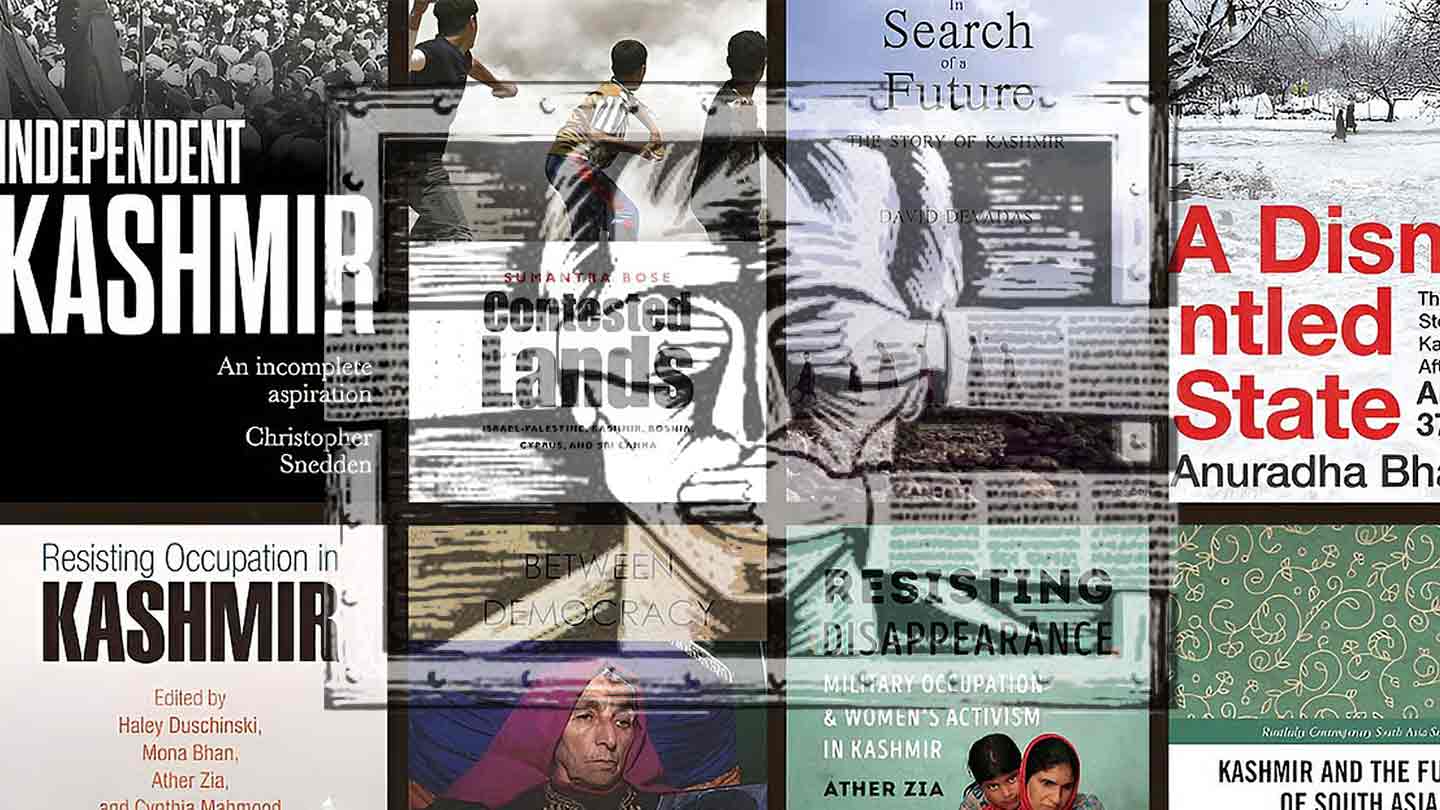
Twenty-five books on Kashmir suddenly suffered an enforced disappearance, striking at the very foundation of democratic discourse and freedom of expression. The recent blanket ban, signaling an unprecedented mass censorship, by Jammu and Kashmir's Home Department, targeting scholarly works including my own 'A Dismantled State: The Untold Story of Kashmir After 370', reveals that the government is so insecure about its narrative that it cannot tolerate even academic scrutiny.
The banned list reads like a who's who of Kashmir scholarship and includes works by A.G. Noorani, Sumantra Bose, Christopher Snedden, and Victoria Schofield. They authors are all known authorities on Kashmir. These are not fringe publications but rigorously researched academic works that enrich studies on Kashmir.
If such books are to be pushed into a black hole, it would be impossible to grasp a comprehensive, layered and nuanced understanding of one of the most troubled regions in the world.
This is not the first time that books have been banned in India, but this case is egregious. 25 books have been targeted on vague, insubstantial grounds at an unprecedented scale. This is not only a shocking testament to the brazen censorship of the government, but it also reflects Kashmir’s dystopian reality.
According to the official notification, the banned books are “playing a critical role in misguiding the youth, glorifying terrorism and inciting violence against Indian State”. It adds that the identified books have been found to “incite secessionism and endanger sovereignty and integrity of India”. The claims are misleading and based on whims, not evidence.
The notification mentions nebulous accusations of promoting "false narrative" and "secessionism" without providing specific evidence or clear definitions of what constitutes such violations. It justifies the ban on basis of investigations but neither offers a detailed analysis, nor concrete examples of how these books in full, some passages from them or some words were promoting the said objectives. This is substituted by bureaucratic doublespeak that criminalises critical thinking totally.
None of these works glorify terrorism or peddle any hidden agenda, as is being claimed by the government. Most of these books are published by reputed publishing houses who certainly do not publish random stuff without ensuring that the research and evidence provided for every assertion is thorough. Particularly in the case of Kashmir, which has been the most contested space, the publishers are extremely cautious and often add a double layer of scrutiny
My own work is an outcome of over two years of research, authenticating and writing. A journalistic narrative on Jammu and Kashmir after it lost its special status and statehood in 2019, it is based on sources in the public domain, interviews and field work, beside analysis of the new laws and policies, historical context, and how these impact people on the ground.
Since it was critical of the state and was written in times when Indian government had begun to exacerbate its high-handed control in Kashmir showcasing the state’s intolerance to any dissent or counter narrative, Harper Collins India, my publisher, treated the region as even more sensitive. The editors implemented rigorous fact-checking protocols and multiple review stages with every assertion thoroughly documented and verified.
My book survived three tedious legal vettings, with publishers verifying every claim against evidence before approving the publication.
The book was written to put into the public domain the truth about the government claims on Kashmir while silencing all voices of dissent, targeting journalists, eliminating civil society spaces and crushing political activism. This was implemented by turning Jammu and Kashmir, geographically truncated and politically demoted to a Union Territory, into a police state and surveillance state.
Like many other books on the list which formed a significant archive on Kashmir’s history and politics, my book documented the contemporary period filling in the vacuum on information and knowledge about the region in the absence of media reportage.
This ban, even as it is unprecedented, is not a case aberration. It's part of a systematic dismantling of intellectual freedom across India—curriculum changes in universities, control over academic appointments, the muzzling of dissenting voices in media and civil society. Kashmir, already transformed into a surveillance state, now serves as the laboratory for this broader authoritarian experiment.
It highlights two ironies. One, the government is contradicting its own narrative of normalcy and peace by banning literature it deems as glorifying terrorism and a source of potential disruptor to peace. Second, a government that proclaims India as the "mother of democracy" while simultaneously destroying the very institutions that make democracy possible.
The real damage of the ban notification extends far beyond the 25 banned titles.
When governments can arbitrarily criminalise academic work, it creates a chilling effect. Researchers and scholars may be scared to research sensitive topics. Publishers may not risk going ahead with critical scholarship? Students will not choose to study regions deemed too “seditious” for honest inquiry.
This creates a feedback loop of ignorance. Without rigorous academic engagement, public understanding becomes shallow and polarised. Policy decisions get made in information vacuums.
But that probably is the intended purpose behind the ban - to send a chilling message, to make it clear that only the version of history and politics stamped and endorsed by the government is acceptable, that no dissent or counter narrative is legitimate, and that all knowledge and information must be dispensed with.
The notification that calls for ban and forfeiture of all the banned books is as much a threat for those who read and keep books to quench their thirst for knowledge as it is for the writers and scholars yearning to research and write.
Such bans may seem senseless in today’s hi-tech digital world when absolute erasure of the written and spoken word is impossible. Yet, they have far-reaching and damaging consequences as they instill a fear of scholarship, research, academics and knowledge, resulting in generations that will hesitate to write, read, and thus think.
No great nations are formed by reducing its citizens to ill-informed entities without the ability to think.
(Anuradha Bhasin is the Managing Editor of Kashmir Times and author of ‘A Dismantled State: The Untold Story of Kashmir After 370’.)
This is a slightly altered version of an article previously published in TRT Global on August 10, 2025 (trt.global/world/article/f8d4b2eb46da).