
The timing is revealing. It now appears clear why the bill was suddenly introduced without prior consultation or proper intimation. The bill, which has now become an Act with the President’s assent, was passed just one day before the NDAA, paving the pathway for a cartographic threat. The Act, which is nefarious and scientifically flawed at its core, has three major pitfalls:
- Extremely low liability and compensation regime, with little to no supplier liability, leaving the burden ultimately on taxpayers and the public.
- Disregard for recent global experiences in handing over energy sectors with wide societal impact to private players motivated primarily by profit.
- Lack of robust regulatory oversight, which becomes more dangerous in the context of Modi government’s “Ease of Doing Business” approach, whose adverse impact was reflected in the recent Indigo crisis, where the DGCA was caught unprepared.
And it’s just Modi’s “dear friend, Trump”, the government all-weather crony capitalist buddy Adani, who enjoys wide-range of monopoly, is eyeing to enter Nuclear power generation based on small modular reactor (SMR). The push for maximising nuclear power rapidly, including by Trump is aimed at feeding booming demand for energy hungry artificial intelligence data centres. With all dots connected behind the SHANTI Act’s objective and purpose, let’s look into details.
Nuclear Energy Is Not Merely Another Industry!
Nuclear energy is not an ordinary industry. When it comes to energy, Nuclear power is an ultra-hazardous technology, where even minor lapses in design, operation, or maintenance can have irreversible consequences. Unlike a fuel or chemical leak, or other material dangers in other forms of energy generation, nuclear has continent-wide impact. This is precisely why India’s nuclear sector was historically kept under strict public control through the Atomic Energy Act, 1962. Yet the Act opens the entire nuclear fuel cycle, from uranium mining to fuel fabrication, reactor operation, and reprocessing to private and foreign companies, while capping liability for accidents at figures that are minuscule compared to potential losses.
At the heart of the SHANTI Act lies its most dangerous feature: a severely diluted nuclear liability framework and creates a graded liability regime, where the operator’s liability limit varies with the reactor’s thermal power or generation capacity. Under the Act, operator liability is capped between Rs. 100 crore (Reactors up to 150 MW, fuel cycle facilities (other than spent fuel reprocessing, and transport of nuclear materials) and Rs. 3,000 crore (Reactors above 3,600 MW thermal capacity), figures that are absurdly inadequate when compared to the scale of potential nuclear damage. For context, the Fukushima cleanup alone has already exceeded $180 billion, with costs continuing to rise.
When the Civil Liability for Nuclear Damage Act (CLNDA) of 2010 was brought as part of US-India Nuclear deal, people across the country had protested against the dangers. Infact, the BJP itself had condemned the lack of liability and compensation and threat of Nuclear catastrophe. To quote, the then BJP leader and former Union minister Yashwant Sinha, on behalf of the party said in a letter “The liability under Price Anderson Act of the US is $12.5 billion which is 23 times higher than the liability fixed for an Indian operator. Clearly, the life of an Indian is only worth a dime compared to the life of an American."
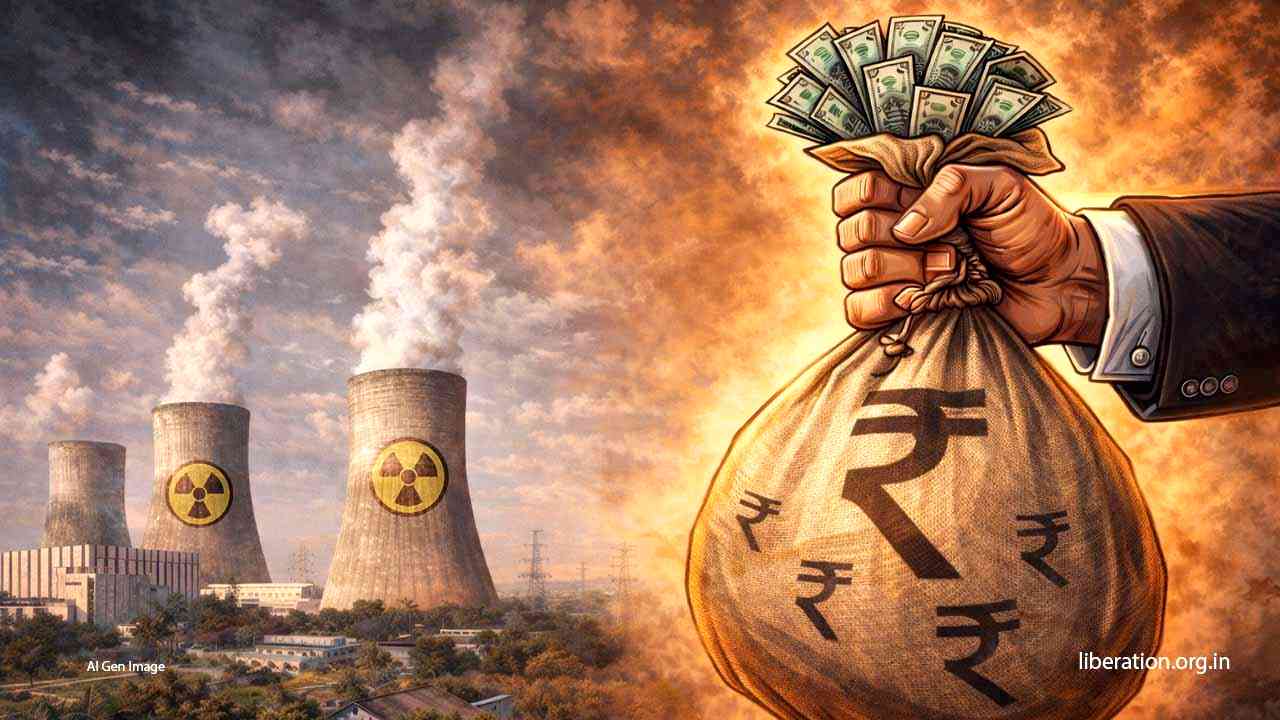
Now, the Modi led BJP regime retains the same liability architecture, merely adjusting numerical caps as per the reactor capacity with a maximum limit of 300 Million Special Drawing Rights (approximately ₹3,900 crore under present exchange rates). The bill also omitted a provision in the CLND Act that allowed supplier liability and the right of recourse against suppliers to contractual situations. This means equipment manufacturers and foreign vendors can escape significant responsibility, even where equipment faults contribute to an accident.
With power plant capacity determining the liability of operator, with Adani planning to go nuclear with experimental SMR, small nuclear power generators, helps the operators to be at the lower end of the liability. Under the SHANTI Act, regulators can grant exemptions and relax safety requirements for SMRs, often citing vague categories like “insignificant risk,” further weakening oversight. The SMRs will enjoy near-total legal and financial immunity under the new act, while being deployed closer to population centres, multiplying risk under the guise of innovation. But does it mean, the SMRs it will eliminate meltdown physics, systemic failure, or societal impact? No! There is no “insignificant risk” when it comes to nuclear and radioactive materials and even a small aberration can have cascading health, environmental, and socio-economic consequences.
The entire regulatory framework under the SHANTI Act creates immense loopholes, effectively setting the stage for a “waiting-for-disaster” scenario. The Atomic Energy Regulatory Board, even if given statutory recognition, remains subordinate to a government that is simultaneously promoting nuclear expansion, issuing licences, and underwriting liability. This conflict of interest undermines independent oversight and leaves ordinary citizens exposed to the consequences of any accident, with no one truly accountable until disaster strikes.
Fukushima: Why Nuclear Energy Cannot Be Privatized
The Fukushima Daiichi nuclear disaster of 2011 stands as the most damning real-world example of why nuclear energy cannot be entrusted to private, profit-driven corporations. The operator, Tokyo Electric Power Company (TEPCO, a private utility company was running the plant. It is interestingly, to note that, Japan’s energy sector was privatized after the World War II under the pressure from the US.
Long before the earthquake and tsunami struck, TEPCO had a documented history of systematic regulatory violations, falsified safety reports, and ignored risk warnings. Independent investigations after the disaster revealed that TEPCO had been warned repeatedly, by its own engineers and by external experts about the inadequacy of tsunami defences and backup power systems. These warnings were disregarded.
During the crisis itself, TEPCO’s conduct further exposed the dangers of privatization. One of the most shocking examples was the company’s reluctance to inject seawater into the overheating reactors, despite clear scientific consensus that it was the only way to prevent meltdown. Why? Because seawater would permanently damage the reactors, rendering them economically useless.
Even after the disaster, TEPCO attempted to underreport radiation releases, delayed evacuation orders, and sought to minimize its financial liability. Ultimately, the Japanese state had to nationalize TEPCO de facto, with public and taxpayers paying while privatized profits from decades of operation remained untouched. The government injected $12.5 billion of capital into TEPCO in exchange for majority voting rights in the company, effectively signalling that for private operators and utilities it can be ‘business as usual’ after the disaster.
Several zones, especially around the Fukushima Daiichi nuclear plant, remain no-go zones even today. Radiation levels are too high for permanent residence. Forests, mountains, and surrounding ecosystems were never fully decontaminated, so radioactive materials continue to circulate through soil and water.
The future cost of Fukushima disaster is expected to be around $728 billion including long term decommissioning, environmental management and indirect economic impacts. It is not just Fukushima. Past nuclear disasters such as Chernobyl in 1986 and Three Mile Island in 1979 show the catastrophic human, environmental, and economic consequences of nuclear accidents. Chernobyl caused tens of thousands of long-term deaths and made entire towns uninhabitable, with cleanup costs exceeding US$235 billion, while Three Mile Island led to evacuations, widespread fear, and cleanup costs of US$1 billion. These cases underline that nuclear accidents, regardless of scale, have long-term impacts far beyond the liability limits envisaged under the SHANTI Act.
Remember Bhopal?
India’s own history provides a stark warning. The Bhopal gas disaster of 1984, though a chemical accident, offers a blueprint of what happens when government negligence meets corporate profiteering. Thousands died immediately, while hundreds of thousands suffered chronic illnesses, including respiratory disorders, neurological damage, and reproductive health problems. Environmental contamination affected soil, water, and farmland for decades.
Union Carbide, the parent multinational corporation, largely escaped liability, leaving the Indian government and victims to fight prolonged legal battles for compensation. Justice was delayed for decades, and settlements were grossly inadequate. While Bhopal was chemical in nature, a nuclear accident could be orders of magnitude more devastating, affecting millions, rendering land permanently uninhabitable, and creating health and environmental crises spanning generations.
The SHANTI Act institutionalises the very logic of ‘Profit Over People’ that allowed Bhopal, Fukushima and other tragedies to occur. By prioritising corporate profit and foreign interests over citizen safety, environmental protection, and national security, the Act turns India’s nuclear program into a high-stakes gamble with the lives of millions.