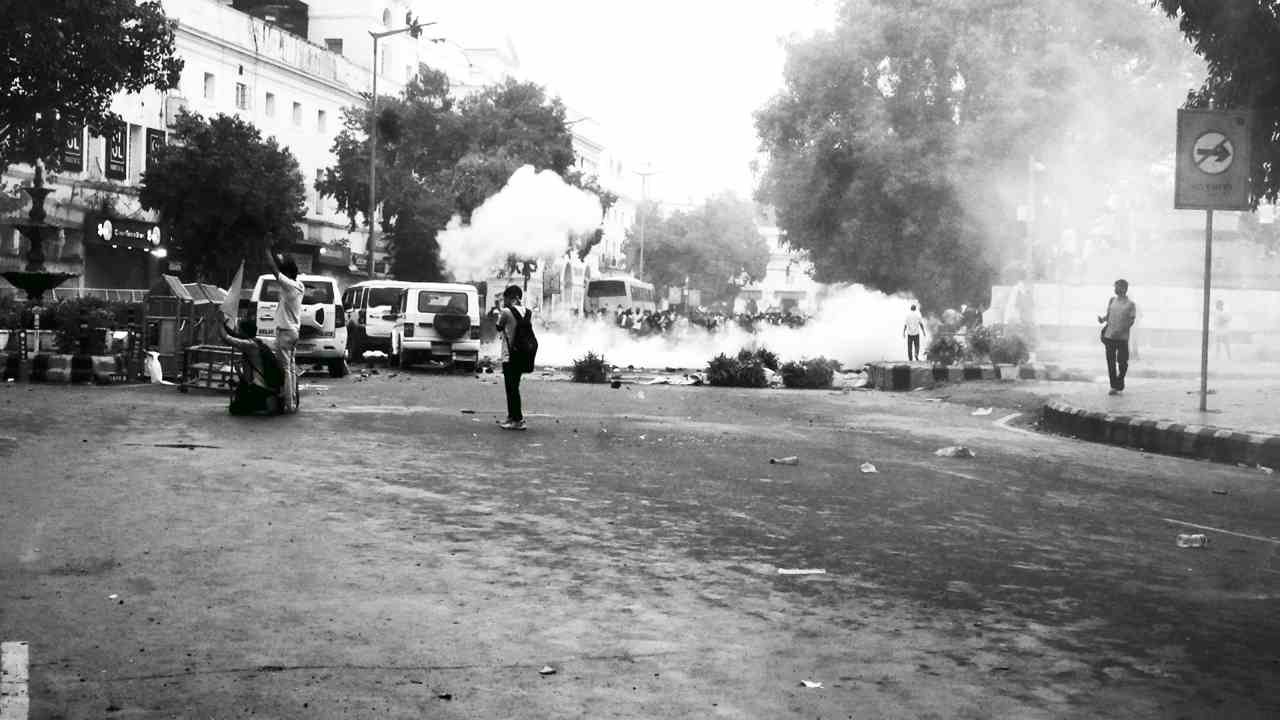
What unfolded at Connaught Place was not the beginning of the day's events, but its brutal climax. It marked the peak of more than ten hours of relentless police repression that had begun at dawn. As our correspondent took out his camera to document the state violence unfolding in the heart of Delhi, the grainy black-and-white footage it captured evoked haunting parallels with archival images of British colonial repression during the Quit India Movement. This time,it was the Quit Education Minister Dharmendra Pradhan movement.
What transpired on July 20 was perhaps best summed up by AISA President Neha in her speech at Jantar Mantar on July 21: "The marks on the bodies of the students present here will bear witness to the meaning of the word 'terrorist'. In the dictionaries, when the words 'terrorist', 'terror', 'fear' and 'violence' are defined, the name of the Delhi Police will be recorded repeatedly. We will remember you."
Hundreds of pairs of footwear, slippers, sandals and shoes abandoned by protesters during the police assault now lie at Jantar Mantar as silent testimony to the terror unleashed on July 20. Each pair stands as a witness to the brutality inflicted upon students and youth who had assembled to exercise their democratic right to protest.
Hunger Strike and Crackdown at Jantar Mantar
The Cockroach Janata Party, along with student organisations including AISA and others, had called for the Parliament March on July 20. The movement had completed one month of its indefinite sit-in at Jantar Mantar, while the solidarity hunger strike undertaken by AISA activists alongside climate activist Sonam Wangchuk had entered its 23rd day. The fast concluded as the march commenced.
Comrades Neha, Manish and Aameen ended their hunger strike following an appeal by a delegation comprising CPI(ML) MP Raja Ram Singh, RJD MP Manoj Jha, CPI(M) leader Amra Ram, Dr Yogendra Yadav, Advocate Prashant Bhushan, Professor Atul Sood, and actors Prakash Raj and Shabana Azmi. The other three hunger strikers, Comrades Danish Ali, Deepak and Hrishikesh, had been compelled to end their fast earlier after developing severe medical complications.
These events unfolded against the backdrop of the shocking kidnapping of Sonam Wangchuk by plainclothes police personnel from the protest site on July 18. Attempts were also made to kidnap AISA activists, but the comrades successfully resisted the police's attempts. Following this hijacking of the movement's leadership, CJP founder Abhijeet Dipke, along with several others, also began an indefinite hunger strike.
White bedsheets emerged as a new symbol of the state's attempt to conceal accountability and facilitate repression. Sonam Wangchuk was forcibly taken to Safdarjung Hospital, but he refused to end his fast until the demands of the youth were met, including accountability for the paper leaks and the resignation of Education Minister Dharmendra Pradhan.
What the police failed to understand was that, over the past month, Jantar Mantar had transformed from merely being a landmark in Delhi into a living space of dissent, defiance and creative resistance. It had become a safe and welcoming space for women, children, students, youth and everyone who dreamed of change. People from every walk of life and every section of society came together to build and sustain this movement. From political posters, revolutionary art and songs by AISA, SFI, AISF and other comrades, to the creative memes, reels and cultural expressions of Gen Z, Jantar Mantar had evolved into a vibrant carnival of resistance.

July 20: When Delhi Shook
On July 20, as Sonam Wangchuk remained detained at Safdarjung Hospital and preparations for the Parliament March were underway alongside the culmination of AISA's hunger strike, massive double-storey barricades were being welded around Jantar Mantar in an attempt to cage the movement. At the same time, a large contingent of police entered from the rear of the Jantar Mantar protest site and launched a brutal assault on the movement's leaders. CJP founder Abhijeet Dipke was picked up and several AISA leaders were seriously injured. Even before the Parliament March began, police in several BJP-ruled states had launched a pre-emptive crackdown, detaining students and youth leaders, including AISA leaders in Uttarakhand, to prevent them from joining the march in Delhi.
The state and its repressive machinery forgot that no cage forged by it could hold the will of a generation fighting for its future. Beyond the barricades, the crowd kept swelling. Despite roadblocks at every nook and corner of Delhi and the city being turned into a military zone, students, youth, parents and people from every section of society continued pouring in. All roads leading to Jantar Mantar were flooded with people determined to march peacefully. The air reverberated with slogans of Inquilab Zindabad, Jai Bhim and Vande Mataram. Portraits of Shaheed Bhagat Singh, Dr B.R. Ambedkar, Mahatma Gandhi and others rose above the sea of protesters.
Suddenly, at around 9.30 am, internet services were completely suspended across an area spanning nearly two kilometres, a shutdown that continued until late evening. Police repeatedly blared announcements over loudspeakers declaring the imposition of prohibitory orders, warning people not to assemble and ordering them to remain inside the barricades. The swelling crowd refused to budge. One young woman mocked the police's repeated announcements in the style of a viral SpongeBob meme, turning the state's warnings into a moment of collective defiance.

The police responded with repeated lathi charges, but failed to disperse the crowd.
Soon, the towering double-storey barricades surrounding Jantar Mantar were breached and a virtual tsunami of Gen Z youth, students, parents and civil society activists surged towards Parliament Street.
From that moment onwards unfolded one of the most brutal episodes of police violence witnessed in recent years. Women protesters were molested. Senior police officers were seen slapping and beating women and even children. Lathis were used until they broke. Shock batons were deployed. Nail-studded batons were wielded against protesters. Heads, necks, backs, stomachs, legs and even private parts were targeted. No part of the human body was spared. Senior police officials were heard exhorting their personnel to "beat them to a pulp" and describing it as "an experience". Some of the worst violence was unleashed by plainclothes personnel, whom the police later claimed belonged to a special unit. Most police personnel in uniform had also removed or concealed their name identification plates.
Despite wave after wave of lathi charges, the peaceful protesters marched on and reached Sansad Marg roundabout. It was impossible to count the number of injured. Many lay bleeding from their heads and faces. Even office-goers and passers-by who happened to be in the area were mercilessly beaten, as though the police were competing in a grotesque contest of brutality.
At one point, a small group of protesters had gathered on the opposite side of the Parliament Street barricade. A senior police officer personally asked them to cross over and join the main protest. The barricades were opened and the students began walking forward. Barely a few seconds later, the police cynically launched another lathi charge on these completely unsuspecting youth.
By then, reports had also emerged that earlier in the day another large group of protesters had successfully reached the new Parliament complex, only to be met with tear gas and a brutal lathi charge. Visuals from the area showed CRPF personnel taking positions with firearms and water cannons inside the Parliament complex.
The harder the batons struck the bones of the youth, the stronger their resolve became. By around 3 pm, every barricade leading up to Sansad Marg had fallen. The entire stretch of Sansad Marg leading towards the old Parliament complex was filled with protesters. Some marched forward raising slogans, some sang songs of resistance, while others met strangers who quickly became comrades in a common struggle.
Soon afterwards, the police launched another massive assault, firing tear gas shells indiscriminately while carrying out a full-scale lathi charge that pushed protesters from Sansad Marg towards Parliament Street and eventually into Connaught Place. Tens of thousands of young people filled Connaught Place and the surrounding areas. It was here that the repression reached its most savage form. Tear gas shells exploded continuously as police personnel chased protesters through roads and narrow lanes, beating not only demonstrators but even ordinary office-goers returning home.
Every road and every lane of Connaught Place bore testimony to the violence. The entire area was engulfed in the choking smell of tear gas. It also became increasingly evident that the police were using pellet-type ammunition, with several people suffering piercing injuries.
Yet the determined youth refused to retreat. They doused tear gas shells with water, shared drinking water, treated one another's injuries and helped those struggling with burns, breathing difficulties and the effects of tear gas. Amid the unprecedented brutality, we witnessed an extraordinary spirit of solidarity. Men, women, children, the elderly, friends and strangers stood together, helping one another in every possible way.
Having completely failed to disperse the protesters, the Modi government and the Delhi Police watched as thousands regrouped at Jantar Mantar and re-energized the movement. This time, the protest spilled far beyond its original site, engulfing the surrounding areas as ever-growing numbers of people gathered to demand justice, accountability and the right to a dignified future.
Voices of Condemnation Across India and the World
The unprecedented crackdown on students and youth shook the conscience of the entire country. Owing to the complete internet shutdown imposed across central Delhi, the horrific visuals of the police assault began reaching the public only later in the evening, when they flooded social media. By the time reports of the brutality started emerging, hundreds had been admitted to hospitals. One young woman was in the ICU with a fractured skull, while several others had suffered pellet injuries, including suspected eye injuries.
Condemning the violence unleashed on students and youth, CPI(ML) General Secretary Dipankar Bhattacharya said that the events of July 20 exposed the Delhi Police as a force acting like goons to crush a democratic movement. He said the repression was part of a larger conspiracy to suppress the movement, just as the Modi government had attempted during the farmers' movement and the Shaheen Bagh movement. But, he asserted, July 20 had also demonstrated the determination of India's youth. Far from intimidating them, the brutality had strengthened their resolve to carry forward the struggle for better education, accountability and justice with even greater determination.

On July 21 and 22, protests in solidarity with the student-youth movement rapidly spread across the country. In Mumbai, despite heavy police repression, massive demonstrations and acts of defiance continued unabated. In Patna, AISA participated in a massive protest march towards Raj Bhavan on July 22. The march was met with police lathi charges and water cannons, but the determined students broke through the barricades and marched ahead. CPI(ML) MLA Sandeep Saurav and MLC Shashi Yadav joined the protest and strongly condemned the BJP government's assault on students whose only demand was justice and accountability.

In West Bengal, protests were on July 20 against police brutality in several districts including a massive march in Kolkata on July 21 by left students organisations.
Protests condemning the Delhi Police crackdown and demanding the resignation of Education Minister Dharmendra Pradhan, the disbanding of the NTA, the scrapping of the NEP, and affordable, quality and inclusive education for all were organised in Uttarakhand, Jharkhand, Bengaluru, Chandigarh, Surat, Hyderabad, Kerala, Lucknow Andhra Pradesh and several other parts of the country.
As this article goes to press, disturbing reports are emerging of massive police firing on youth in Bihar's Jehanabad on July 23, where they were demanding accountability for the paper leaks.
The Indian diaspora also strongly condemned the violence against students and youth. Protest demonstrations were organised in London, Amsterdam and several other cities across the world. On July 20, Indian diaspora members, Indian students and solidarity activists organised a major protest outside the Indian High Commission in London in solidarity with the students and young people resisting repression in Delhi.

In its statement, the South Asia Solidarity Group declared its unconditional solidarity with the students and young people who had taken to the streets of Delhi in their hundreds of thousands, demanding the resignation of Education Minister Dharmendra Pradhan as part of a sustained struggle against corruption. The statement observed: "It is no surprise to us that the Modi government has responded to the students' movement first with indifference and now with violence. Their attempts to suppress the protests, from barricading Delhi's major thoroughfares and placing supporters under house arrest in towns across the country, to unleashing lathi charges, brutal beatings and tear gas, have made this about far more than education. It has shown the world that the Modi government and the RSS will stop at nothing to crush democratic protest."
On July 23, CPI(ML) MPs Raja Ram Singh and Sudama Prasad joined fellow INDIA Alliance MPs in visiting Gandhi Smriti in Delhi to express solidarity with the student-youth movement. The CPI(ML) MPs unequivocally condemned the brutal police crackdown of July 20 and demanded strict action against the officials responsible for unleashing violence on peaceful students and youth exercising their democratic right to protest.
The Silence and Hollow Promises
On July 22, the issue of police brutality against students and youth was mentioned before the Supreme Court. However, Chief Justice Surya Kant refused to urgently take up the matter, remarking, "Don't waste our time." Just as the Cockroach movement itself was triggered by the Chief Justice's earlier remarks, these words of July 22 too will be remembered by history.
As Jantar Mantar and its surrounding areas transformed into a full-fledged site of resistance and defiance, the Modi-Shah regime, instead of addressing the demands and growing discontent of the youth, intensified its tactics of repression. Around sixteen Metro stations surrounding Jantar Mantar were shut every day. Internet services in the area continued to be suspended, while police personnel routinely stopped, questioned and intimidated young people attempting to reach the protest site.
After a long silence, Prime Minister Narendra Modi finally issued a statement. Yet, instead of responding to the concerns and demands raised by the students and youth, he attempted to divert public attention with another announcement, a fast-track court, reminiscent of the ₹15 lakh jumla. Even as the Godi media hailed the announcement of a fast-track court as the government's answer to the paper leak crisis, another development laid bare the hollowness of its promises. The CBI had given a clean chit to Sanjeev Mukhiya, earlier described by investigators as the mastermind behind the NEET-UG 2024 paper leak.
But the youth remained clear in their demands and unwavering in their determination. They demanded the resignation of the Education Minister, strict action against the Delhi Police officials responsible for the brutal assault on students and youth, and the withdrawal of all cases against the protesters..
Echoing the demands of the movement and rejecting the Modi government's diversionary tactics, CPI(ML) General Secretary Dipankar Bhattacharya responded to the PM’s statement: "If you want the youth to take your post seriously, start with the resignation of Dharmendra Pradhan. After serial leaks and serial clean chits, the buck stops with the government. Heads will have to roll. Don't forget that July is always followed by August, the historic month of India's independence, when in 1942 the people of India asked the British rulers to Quit India, and five years later the British rulers indeed had to quit."