

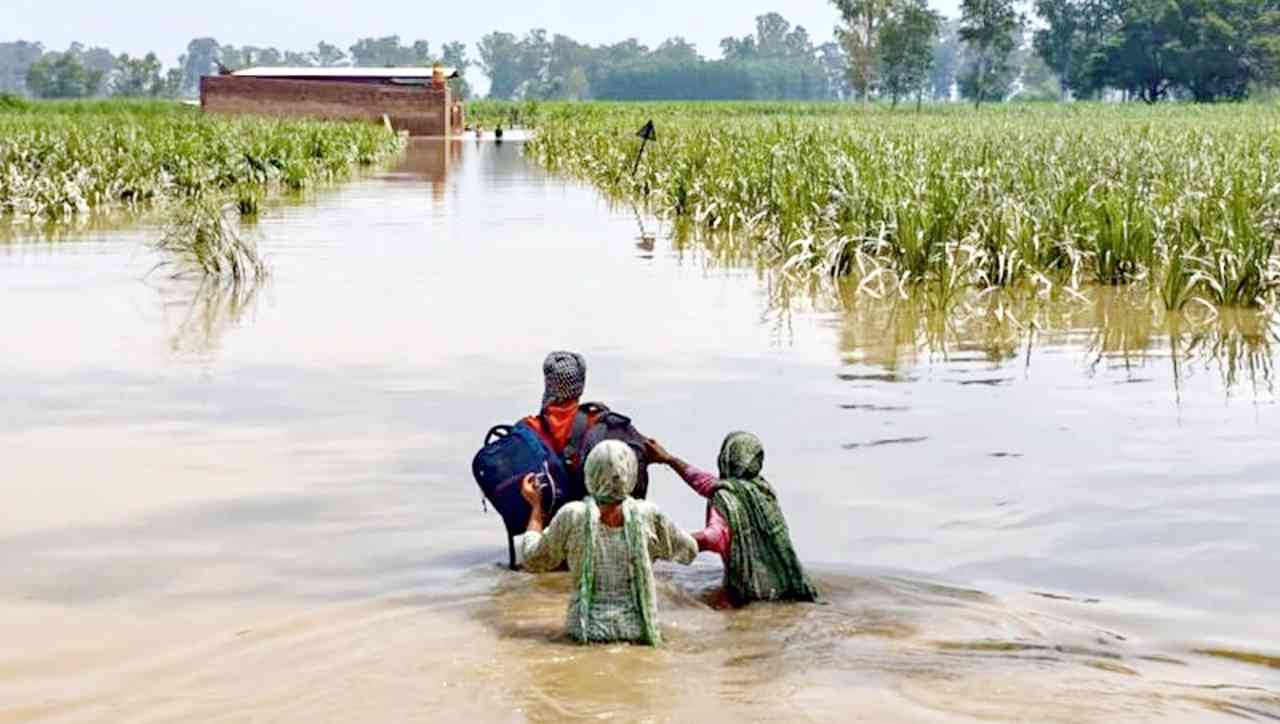
The disaster was amplified by extreme weather events in the Himalayan region. Rivers such as the Sutlej, Beas, Ravi, and Ghaggar overflowed violently, turning fields into lakes and villages into islands. Thousands of hectares of cultivable land now lie under water, endangering wheat and rice production, the backbone of India’s grain reserves. Farmers have lost standing crops, livestock has perished, and irrigation systems lie in ruins.
The floods have dealt a particularly cruel blow by striking during harvest season. Large stretches of paddy, Punjab’s main kharif crop, were only weeks away from being harvested when they were submerged. Now, not only is the standing crop lost, but fields left buried under silt and sand will take weeks to recover. This will delay the sowing of wheat in November, threatening the upcoming rabi crop as well. This double blow threatens both the present kharif harvest and the upcoming rabi season.
Experts and farmers’ organisations point to administrative lapses as critical factors that worsened the crisis. Natural drainage channels were blocked by construction projects and unscientific highway building, while crucial desilting of the Sutlej was initiated only in June, far too late for monsoon preparedness. Surveys had already identified millions of cubic feet of silt at critical sites, and timely clearance could have reduced the severity of the flooding. Instead, bureaucratic delays and lack of urgency allowed the disaster to spiral.
Down To Earth also notes that crucial dam data, especially under the BBMB, was withheld during the 2025 floods despite legal obligations, and with Punjab’s reduced role in the board and no regular government bulletins, people had to rely on activists and media, which worsened the crisis.
The Punjab government also failed to issue regular bulletins or press briefings on dam inflow/outflow, water levels, and related updates. Most information reached the public via private channels, activists, or media instead of state sources. The absence of transparent, real-time dam data and coordinated communication worsened the disaster’s impact and left people unprepared.
To fix accountability and take action against those responsible for this flood and devastation, Samyukta Kisan Morcha (SKM) Punjab has demanded the formation of a time-bound judicial commission headed by a sitting judge of the Punjab and Haryana High Court. It has also demanded immediate interim relief of Rs. 1 lakh for each flood-affected family. While seeking changes in compensation norms, SKM has demanded that compensation be given per acre as a basic unit and strictly “according to the extent of damage.” SKM has demanded a special survey of affected areas and compensation of Rs. 70,000 per acre for damaged crops, Rs. 1 lakh per acre for damaged sugarcane, Rs. 10 lakh for the family of each deceased person, and Rs. 1 lakh for livestock loss. For collapsed houses, Rs. 10 lakh compensation, and for damaged houses, appropriate compensation.
Adding salt to the wound, when it is expected from the Punjab government to take effective measures to clean the fields of accumulated sand and silt, it is trying to leave this job on the farmers themselves in the name of a scheme launched with the name of ‘Jiska Khet, Uska Ret’ (that sand mining licences won’t be required for selling sand from the farmers’ fields till December 2025). This is nothing but a ploy to escape the responsibility on the part of the state government.
Moreover, Punjab has not opted for the central crop insurance scheme, nor does it have any alternative scheme of its own. Now it's the government’s responsibility to compensate farmers for losses incurred due to floods.
The CPI(ML), reiterating the demands raised by farmers’ unions, has called on the Government of India to immediately declare Punjab a national disaster and release a special flood relief package for the region. Without such measures, Punjab’s farmers and the nation’s food security will face an even deeper crisis.