SIR, Electoral Engineering, and the Capture of State Power
The SIR process became central to a broader project of electoral engineering and the capture of state power. The BJP’s rise was facilitated through administrative manipulation, militarised fear, extensive financial expenditure, media-driven anti-Muslim propaganda, and the exploitation of anti-incumbency sentiment against the Trinamool Congress. Concerns regarding institutional collusion between the BJP-led central government and the Election Commission by introducing changes in the appointment process of the Chief Election Commissioner in 2023, which increased executive influence over the Election Commission by removing the Chief Justice of India from the selection committee. In Bengal, the deployment of special observers and micro-observers during the SIR deepened apprehensions of selective targeting and political bias, which could be observed in the near absence of intervention in cases of open hate speeches by heavyweight BJP candidates, including the current chief minister, Shuvendu Adhikari, during their electoral victory.
These concerns were reinforced after the election, when Election Commission special observer Subrata Gupta was appointed advisor to Chief Minister Suvendu Adhikari, and Chief Electoral Officer Manoj Agarwal was made Chief Secretary of the government, blurring the line between electoral administration and partisan state power.
Post-Poll Violence: Fear-Mongering, Communal Targeting, and Misogyny
The atmosphere of administrative impunity and majoritarian aggression cultivated during the election rapidly spilt into the streets after the results were declared. The post-poll violence that followed reflected not isolated incidents of political retaliation, but a broader pattern of communal targeting, patriarchal violence, and the public assertion of majoritarian dominance. Across several districts, saffron-clad groups vandalised public spaces, attacked religious and political symbols, and renamed Muslim-associated localities. In North 24 Parganas, decorative gateways on Masjid Bari Road in Barasat were destroyed and replaced with majoritarian signboards, while Siraj Udyan was renamed “Shibaji Udyan.” In Murshidabad, the Lalbagh Eidgah was vandalised, while mobs marched through public spaces chanting “Jai Shri Ram” as a performative assertion of intimidation and control. Videos from multiple incidents showed police personnel and deployed central forces remaining passive spectators during attacks, deepening perceptions of state-enabled impunity. Symbols associated with the Left and indigenous movements were also targeted. Statues of Vladimir Lenin in Jadavpur and Murshidabad were vandalised, followed by attacks on memorials of tribal freedom fighters Sidhu Murmu and Kanhu Murmu, where BJP flags were planted after desecration. Offices of Left parties, trade unions, and grassroots organisations were attacked in multiple districts.
More alarming was the organised communal violence directed against Muslims. According to the Association for Protection of Civil Rights (APCR), at least 34 incidents of anti-Muslim violence were documented between 4 and 7 May across districts, including Cooch Behar, North and South 24 Parganas, Kolkata, Howrah, and Murshidabad. Muslim-owned homes, shops, mosques, cattle markets, and meat businesses were specifically targeted. More than fifty Muslims reportedly faced assault or intimidation, dozens of properties were vandalised, and at least two deaths were reported, including that of a Muslim man attacked while attempting to protect a mosque in Gosanimari.
The post-poll climate was equally marked by the normalisation of misogyny and gendered violence. Women, particularly Muslim women and those associated with opposition groups, faced rape threats, public humiliation, online abuse, and physical assault. Educational institutions also became sites of intimidation. Campuses associated with student dissent and progressive politics, including Vidyasagar University, witnessed unrest and vandalism carried out by ABVP supporters, reflecting attempts to impose ideological conformity through fear and public intimidation.
The New Government: Old Politics of Fear-Mongering and Seizing Rights in the Shiny Wrapper of Development
The BJP government formally assumed office in West Bengal on 9 May 2026, presenting itself as a regime committed to development, nationalism, administrative efficiency, and the restoration of the “rule of law.” Under Chief Minister Suvendu Adhikari, the government quickly launched aggressive investigations into corruption, recruitment scams, “cut money” networks, and financial irregularities linked to the previous regime, projecting itself as a force of accountability and institutional cleansing. However, the selective nature of this anti-corruption narrative remains evident, particularly in the absence of similar scrutiny of controversies involving the BJP or central institutions, including the NEET scam and the continued exclusion of the PM CARES Fund from the ambit of the Right to Information Act. The character of the BJP regime in West Bengal becomes clearer and increasingly familiar in the context of BJP governance in other states when viewed alongside several measures and governing tools introduced immediately after assuming office. These developments indicate not merely a change in administration, but the emergence of a governance model rooted in exclusion, securitisation, punitive state power, and ideological restructuring of public life.
a. Turning voter disenfranchisement into a tool for excluding marginalised citizens from welfare while sustaining the “Bangladeshi infiltrator” narrative
On 14 May, the Bengal government ordered the re-verification of caste certificates issued since 2011, bringing nearly 1.69 crore SC, ST, and OBC certificates under scrutiny. Crucially, the order stated that caste certificates belonging to individuals and dependents whose names had been deleted from electoral rolls during the recent SIR exercise would also be examined and could potentially be cancelled following due process. A similar pattern emerged in the newly announced Annapurna Yojana. Through a gazette notification, the government confirmed that ₹3,000 per month would be transferred to all existing Lakshmir Bhandar beneficiaries except those dead, shifted, deleted, or identified as absentee electors during SIR-2026. Women and Child Development Minister Agnimitra Paul further stated that benefits previously distributed to “Bangladeshi illegal encroachers” and “non-citizens” would be recovered with interest. From senior leaders to grassroots cadre, the BJP is portraying deleted voters as “illegal infiltrators” and undeserving claimants to welfare. This is despite recent Supreme Court directions clarifying that the Election Commission cannot determine citizenship through electoral roll revisions. Yet these developments in West Bengal demonstrate how voter disenfranchisement is increasingly being weaponised to deny access to welfare schemes, caste-based reservation, and socio-economic entitlements, particularly targeting vulnerable and marginalised populations.
b. Eviction of the working class, demolition of homes, and redesigning urban lands through “Bulldozer Raj”
The BJP government’s early urban governance measures in West Bengal signal the emergence of a “Bulldozer Raj” model familiar from several BJP-ruled states, where demolition drives and anti-encroachment campaigns function not merely as administrative exercises but as visible demonstrations of punitive state power. Soon after assuming office, the government announced restrictions on religious activities on public roads in the name of regulating traffic and public order, while simultaneously launching sweeping eviction and demolition drives across Kolkata and adjoining urban areas. A joint operation involving railway authorities and the police administration demolished nearly 150 informal shops and structures around Howrah Station, while an estimated 500 hawkers and street vendors were evicted from the Howrah and Sealdah railway station areas, with similar drives extending to other parts of West Bengal. Although the government justified the hawker evictions as necessary for easing congestion and improving passenger movement, hawkers, informal workers, and economically vulnerable populations dependent on public-space economies for their livelihoods were left without any alternative arrangements or rehabilitation support.
The most significant crackdown unfolded in the Tiljala–Topsia belt following a deadly fire in an unauthorised leather goods factory that killed two workers. In response, the government launched large-scale demolition operations against alleged illegal constructions, disconnected water and electricity supplies, and deployed bulldozers against both factory premises and adjacent residential buildings. The demolitions were carried out without prior notice, rehabilitation discussions, or due process, forcing several families to vacate overnight. The Kolkata Municipal Corporation subsequently identified nearly 3,000 buildings across six designated “red-zone” boroughs for scrutiny over alleged construction-rule violations, including around 1,000 buildings in the Tiljala–Topsia area alone, many of which are likely to be targeted in the coming days. These aggressive demolition and eviction operations indicate a broader attempt to redesign urban spaces by displacing working-class settlements, informal economies, and politically marginal communities from strategically valuable areas of the city.
c. Curtailing religious freedom and harming cattle traders and rural livelihoods
Within two weeks of assuming power, the West Bengal government enforced Animal Slaughter Control Act, 1950, ahead of Eid-ul-Adha, framing it as part of a “total crackdown” on cattle smuggling. Under the law, cattle can only be slaughtered if certified by a government veterinary doctor as permanently incapacitated or above 14 years of age, with violators facing imprisonment of up to six months. The abrupt enforcement of the law immediately generated fear and disruption across Bengal’s livestock economy. Reports emerged from several districts of Muslim cattle traders being harassed and assaulted by vigilante groups linked to the BJP and Bajrang Dal. In one incident in North 24 Parganas, four Muslim men transporting cattle were brutally beaten on suspicion of cattle smuggling before being handed over to the police. In Hingalganj, a BJP MLA intercepted a cattle truck and controversially demanded “birth certificates” for cows to verify their age, while reports of harassment and torture of cattle traders also surfaced from Durgapur and surrounding industrial belts.
The crackdown disproportionately targets Muslims, curtails freedom of religious practice and choice of food, and threatens Bengal’s long-standing culinary and occupational diversity. However, its impact extends far beyond, severely affecting thousands dependent on the livestock economy, including dairy farmers, transport workers, traders, meat sellers, and rural women engaged in cattle-rearing and allied activities. Hindu dairy farmers and cattle traders also reported severe financial distress as the climate of fear and restrictions caused a sharp decline in cattle trade ahead of the peak Eid market season. Many affected dairy farmers have demanded that the BJP government either withdraw the restrictions or take responsibility for their mounting debts and family livelihoods, arguing that the sudden imposition will severely reduce their income and push already vulnerable rural households deeper into financial distress.
d. Repression of democratic voices and shrinking space for dissent
Garga Chatterjee, a professor at the Indian Statistical Institute and a leader of the Bengali nationalist movement, has remained under arrest since 12 May for posts alleging EVM tampering. The arrest waas an attempt to silence dissent by creating an atmosphere of fear and intimidation. On 14 May, police denied permission for a protest in Kolkata demanding his release and heavily deployed police and central forces around the protest site.
On 19 May, protesters opposing bulldozer demolitions, evictions without notice, and restrictions on religious practices in Park Circus faced police repression, resulting in the arbitrary arrest of 48 demonstrators, including civil and human rights activist Faridul Islam. While Chief Minister Suvendu Adhikari publicly labelled sections of the protesters as “anti-national” and “anti-social,” he also defended the arrests and police lathi-charge as necessary for imposing the “rule of law.” The large number of arrests within a span of just a few days reflects an increasingly familiar pattern in which dissent is delegitimised through criminalisation, securitisation, and nationalist rhetoric.
Taken together, these developments reveal that the BJP’s takeover of Bengal is a rapid consolidation of a fascist governance model already visible in several other BJP-ruled states. It's an attempt to fundamentally restructure the state’s democratic and social fabric through fear, exclusion, surveillance, majoritarian nationalism, coercive state power, and the expanding influence of corporate interests. The resistance emerging from the left & democratic sphere, therefore, carries significance beyond immediate electoral politics; it represents an ongoing resilient struggle over the democratic future of Bengal itself.

May 21: Protest meeting yesterday near Sealdah railway station against statewide eviction of hawkers, demolition drive and the post-poll spell of violence and vandalism in West Bengal

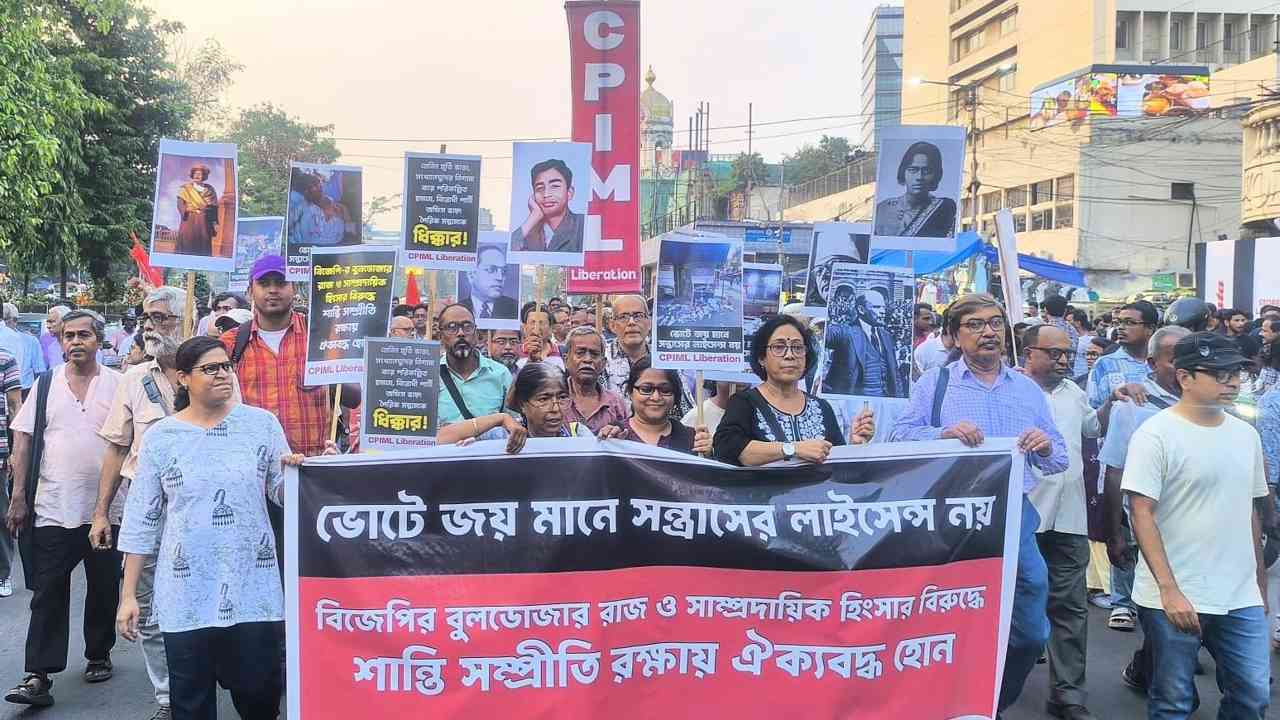
May 08: On a day BJP finalised hate-spewing Suvendu Adhikari as West Bengal's next CM, left activists took out a march in Kolkata against the BJP's campaign of post-poll terror and violence

May 07: Hundreds of Left activists and progressive citizens to assembled in front of the statue of Lenin at Dharmatala (Esplanade), an iconic landmark of Kolkata for the last five decades, on the call of CPIML (Liberation) and SUCI(C) to register their protest against the post-poll spell of terror and violence in West Bengal and reiterate their resolve to maintain communal harmony, protect minority rights and political liberty of all citizens.
**********************

CPIML Liberation Moves Calcutta HC Against BJP Govt’s Attack on Religious Freedom, Livelihoods and Food Rights
CPIML Liberation, West Bengal on May 19 has filed a PIL in Calcutta High Court seeking urgent judicial intervention to stop the order issued by the BJP Government invoking an outdated 1950 law to impose severe punitive restrictions on ritual sacrifice of livestock.
The party has strongly stated that this order is a direct assault on multiple constitutional and democratic rights. It targets the religious freedom of the Muslim community, the livelihoods of farmers and cattle traders, many of whom belong to the Hindu community, the right of citizens to eat according to their choice, and the rich culinary diversity of West Bengal.
The BJP led state government had recently announced the enforcement of the 1950 law to curb the slaughter of animals, including cows and buffaloes, unless certified by a veterinarian. The notification further stipulated that an animal may be considered fit for slaughter only if it is permanently incapacitated or above 14 years of age.
CPI(ML) Liberation said that such restrictions are punitive, unreasonable and designed to create fear among communities whose religious practices, food habits and livelihoods are linked with livestock trade and meat consumption. The move will directly hit farmers, small traders, butchers, transport workers and working people dependent on the livestock economy.
Traders from different communities have also raised strong objections to the government’s move, saying it has created fear and uncertainty in the livestock market and will directly hit the livelihoods of farmers and cattle traders. Many said they had borrowed heavily to buy and rear cattle for Eid al-Adha sales around May 27-28, but the threat of police action and intensified scrutiny has scared away buyers, leaving traders staring at huge losses.