
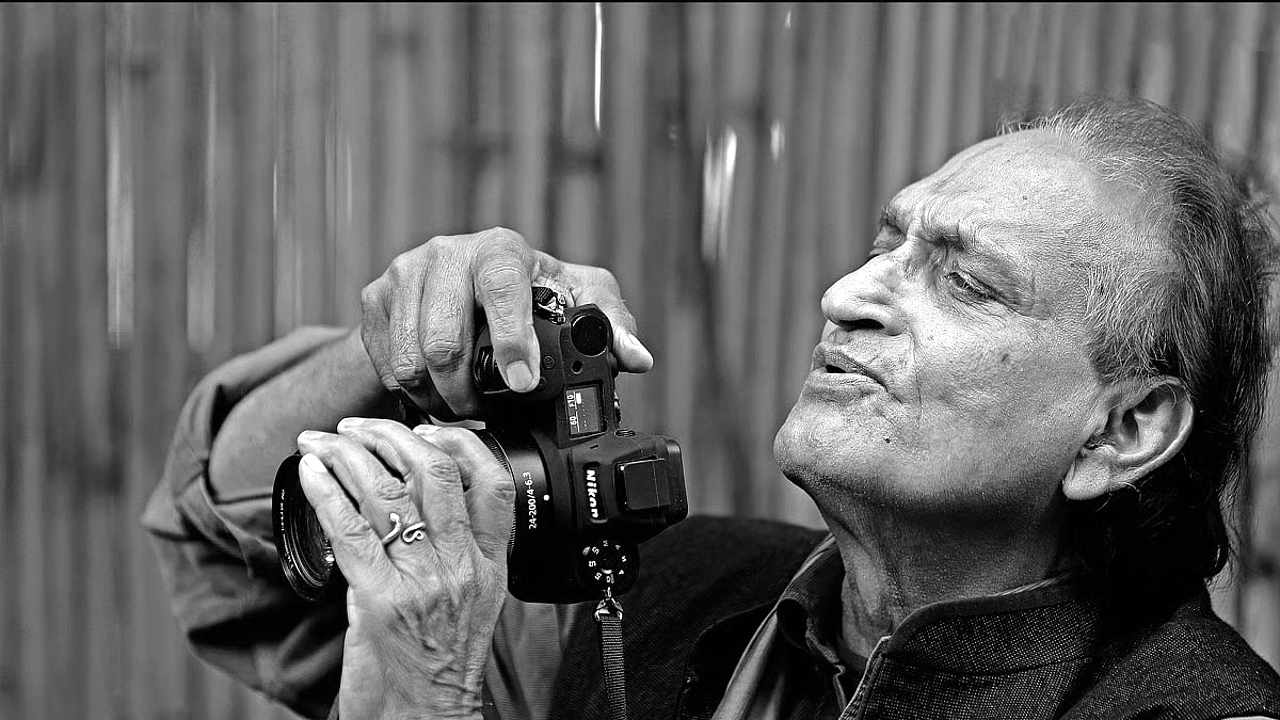
Raghu Rai, was a towering figure, literally and figuratively. Dubbed the “Amitabh Bachchan of Indian Photography” his peers recall his flamboyant style, enhanced by flowing robes that added to his commanding presence. However, behind the glamour was a tenacious professional who helped change the face of Indian photography. His disciplined work ethic spanned six decades and survived the transition from film to digital. With more than fifty photobooks to his name, Rai did not just click a photo, he created a dense archive by building a massive, tangible body of work. He demonstrated a level of productivity that remains unparalleled.
Initiated into photography in 1963 by his elder brother S. Paul – already a working photojournalist, Raghu Rai started his career working as chief photographer for 'The Statesman’ newspaper from 1965 to 1976. This stint significantly shaped his photographic style and approach. It was here that he honed his skill of telling a story in a single image, a cerebral skill but, one built on hands on hard work. Many of the prints he made from that era still stand the test of time, showcasing his photographic skill and still exhibited in several museums and galleries India and across the globe.
Until the 1960s and 70s photography was not an easy way to make a living. Photojournalism was one of the few paths where a photographer was able to earn a respectful wage and newspapers and journals were the only platform for show-casing photographic work to an audience. Images were usually taken and disseminated, and then disappeared into the collective consciousness – this was especially the case with images that witnessed the suffering of others. The work of mid-century photographers who worked in India, such as Sunil Janah and Margaret Bourke-White, largely vanished from public view. Magazines that published their work shut down and were forgotten. The few books photographers published went out of print.
At that time Indian photographers, particularly documentary photographers and photojournalists, followed the pictorial photography movement. A movement that started in Europe in the early 20th Century which was mastered in America, it was a style that Indian photographers adopted whole heartedly. Pictorial photography sought to be artistic and dreamy; but despite this photography wasn't considered worthy as art for nascent gallery space.
Raghu Rai is the photographer who perhaps did most to break that ceiling. He was both published and exhibited widely, everywhere. He was the first Indian and the youngest member of the prestigious Magnum Photo Agency.
In the second half of 20th Century the question of distance, not only optical, physical and psychological, but most of all political, became a common issue for critical discussion amongst documentary photographers and photojournalists - as Robert Capa said, “If your pictures aren’t good enough, you’re not close enough”. “European grammar” as taught by Rai’s mentor, Henri Cartier-Bresson prized subtraction and the isolated "decisive moment," but Rai argued this was insufficient for the Indian ethos. Instead of Robert Capa’s tight, intimate proximity, Rai stepped back to capture “voices over voices”. His frames were intentionally chaotic and layered, reflecting a country where a "main subject" rarely remains the centre of attention for long. The European grammar, subtraction, clean geometry, isolated “decisive moment”, was no help in India.
Raghu Rai belongs to the generation of photographers who turned controversial ideas into subjects for their own artistic and personal exploration. He constantly stepped back, and by using a very wide angle 20mm lens, he utilised the distance between himself and his subject. In essence, his wide-angle lens acted as a "magnifier of space," turning ordinary scenes into dramatic, three-dimensional stories. This allowed him to capture the tense, layered and chaotic essence of Indian life.
Raghu Rai’s legacy is complex. It can be argued that his high-contrast, lyrical compositions risk "beautifying" suffering. By turning a horrific industrial disaster, the 1984 Bhopal Gas disaster for example, into a "poetic" image, it suggests the immediate political urgency can sometimes be softened by the photograph’s artistic grace.
Yet, as the “Rock Star of Indian Photography,” Raghu Rai’s towering influence was matched by a growing body of critical scrutiny regarding how he framed, and perhaps distorted, the Indian reality. It is true that for decades, Rai was the unofficial eyes of the Indian state, standing at the right hand of Indira Gandhi or in the private sanctums of the Dalai Lama. In a country where photography was often restricted by economic controls and elite gatekeeping, his "courtly" access was undeniable. His focus on Sadhus, the Ganges, and crowded street scenes played into Western expectations of a "mystical, chaotic” India. His style is often described as "epic" and "romantic" and it can be argued this sometimes led to a "flattening" of modern India's complexities in favour of a timeless spiritual narrative that ignored contemporary socio-economic shifts of a modernising nation. To some, this played directly into Western Orientalist expectations of a "chaotic yet spiritual" India, effectively turning the country’s modern struggles into a timeless, exotic postcard.
Then there is his body of work of Mother Teresa. Rai’s work could be seen as bearing witness to her work, but smacks of hagiography. While his images are visually stunning, they can be seen as spiritual romanticism. Raghu Rai played a major role in constructing the "saintly" narrative that ignored the more controversial aspects of her missions. By focusing on the "divine light" and the "epic" nature of her work, Rai’s photographs arguably commodified poverty into a backdrop for spiritual drama, satisfying a global hunger for "mystical India" while ignoring the gritty, socio-political causes of the suffering he was framing.
The discourse surrounding Raghu Rai should be about acknowledging his technical mastery and scrutiny of his gaze. While he undeniably shattered the glass ceiling for Indian photography on the global stage, he did so by institutionalising a specific visual language – one that often prioritised the "epic" over the "urgent." By favouring a "timeless" narrative, his work frequently bypassed the raw, unvarnished pulse of a changing nation in favour of a curated, atmospheric reality. Ultimately, Rai did not just document India; he mythologized it, leaving a legacy that is as much a subject of aesthetic wonder as it is a cautionary study in the politics of the romanticised lens.