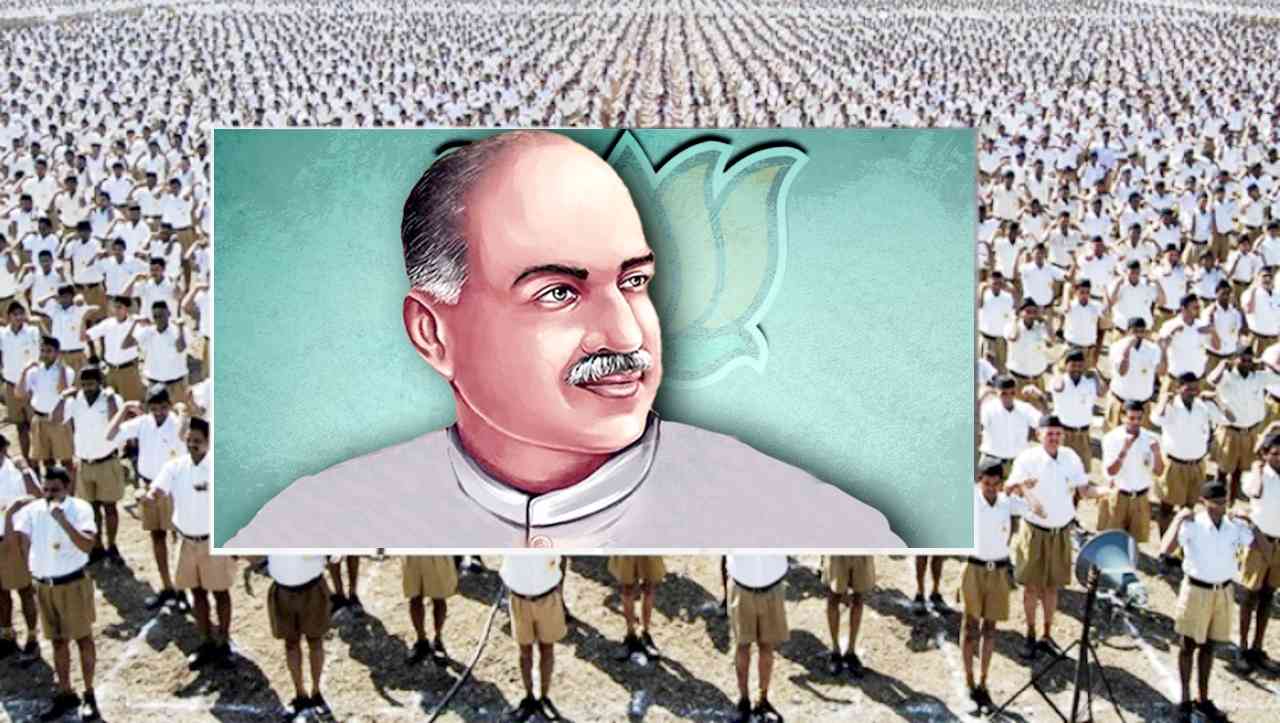
Of the three, the third point can be dismissed with some historical heavy lifting. Judgments of political personalities can be made by how they were seen and treated by their far more prominent contemporaries. Netaji Subhas Chandra Bose, whom Mahatma Gandhi, despite their political differences, called the ‘prince among patriots’, not only despised Shyama Prasad Mookherjee but also threatened to use ‘force’ against him and his party, the Hindu Mahasabha, in Bengal. As a matter of fact, during the Calcutta Municipal Corporation elections, Balraj Madhok records in his biography of Shyama Prasad, ‘‘Subhas Bose’s men would break up all Mahasabha meetings and beat up its candidates. As a result, the Mahasabha candidates got so terrified and demoralised that they would not hold any meetings at all.’’ Madhok and the current servitors of Hindutva claim that Subhas Bose and Shyama Prasad had developed mutual respect for each other. This is far removed from the truth. Netaji, in his book The Indian Struggle, clearly wrote against the Hindu Mahasabha and the Muslim League, calling them both communal organisations. He wrote: ‘‘In accordance with the time-worn policy of divide et impera (divide and rule), the (British) Government greatly encourage these parties — just to spite the Indian Nationalist Congress and try to weaken its influence.’’ He also wrote: ‘‘The Hindu Mahasabha, like its Moslem counterpart, consisted not only of erstwhile Nationalists, but also of a large number of men who were afraid of participating in a political movement and wanted a safer platform for themselves.’’
Subhas Bose was absolutely spot on. In December 1939, when the Hindu Mahasabha was officially launched in Calcutta, a jubilant Linlithgow, the Viceroy of India, wrote to London:
Gradually emerging, and with considerable vigour, as something approaching a political force. (Hindu Mahasabha) have just held a monster-meeting here from which there has emerged a series of resolutions highly communal in character and condemnatory of the Congress...I will not be surprised, things being as they are, if the Mahasabha were to succeed in stealing a certain amount of Congress thunder.
In the 4 May 1940 weekly Forward Bloc that Subhas Bose edited, he again referred to the Hindu Mahasabha and the Muslim League as ‘communal organisations’ and added that ‘these communal organisations have become more communal than before.’ Through archival sleuthing of the Anandabazar Patrika, Snigdhendu Bhattacharya, in his book Mission Bengal: A Saffron Experiment, has shown that exactly eight days later, on 12 May 1940, Subhas Bose again lashed out at the Hindu Mahasabha at a public gathering in Durga Maidan, Jhargram. The Anandabazar Patrika quoted Subhas Bose’s speech in their 14 May 1940 issue as:
Hindu Mahasabha has sent out trident-carrying monks begging for votes. Hindus bow whenever they see the trident and the saffron clothes. Hindu Mahasabha has emerged in the political scene, using religion to pollute it. Remove these traitors from the national life. No one should listen to them…No lie is greater than saying Hindus and Muslims have different interests. Floods, famines, and epidemics spare none.
Shyama Prasad’s political career and nationalist credentials were so distinguished that the British never felt the need to imprison him. The idea of making him the new hero of West Bengal is also churlish. Before his death in 1953, during the 1951-52 assembly elections, the Bhartiya Jan Sangh (the new front of the Hindu right, established on 21 October 1951 under the leadership of Shyama Prasad) lost handsomely. The post-partition, predominantly Hindu population of West Bengal overwhelmingly rejected the communal Jan Sangh and its leader, Shyama Prasad. In Bengal, the Jan Sangh won only nine seats. During the 1962 assembly elections, a bigger disaster struck the Jan Sangh. All twenty-five of its candidates lost their deposits. On the other hand, the Communist Party of India increased its vote share in the state from 10.76% in 1952 to 17.81% in 1957, and to 24.96% in 1962.
In choosing their heroes, the Bengalis will never be swayed by Dasgupta’s myth-making about Shyama Prasad. The Andaman Cellular Jail is adorned with the names of many anti-imperialist Bengalis who were imprisoned there. They were the real heroes of Bengal, alongside the enduring legacy of Netaji Subhas Chandra Bose, whose very name made the imperialists tremble.
Dasgupta’s point about the myth of Bengali syncretism is all the more disappointing. Despite a PhD in history from Oxford, Dasgupta has shown scant regard for the fact that nations, communities, ethnicities, and other social groupings evolve over long periods. In their making, the idea of perpetual enemies and perpetual friends is a matter of conscious choice. Politics also plays a major role in shaping national imaginations. Before American independence, the colonists self-identified as ‘New Englanders’, Virginians, Pennsylvanians, etc. After independence from Britain, an ‘American’ identity was forged. The English began identifying themselves as ‘British’ after the 1707 Union. The vast imperial possessions also reinforced this new self-identification. In India, national identity emerged from the struggle against the British. The secularists imagined a composite, plural idea of ‘Indianness’ in which all communities co-existed, whereas the jaundiced eye of the communalists saw eternal strife and mutual enmity among religious communities. The latter group, the communalists, were largely pro-imperialist, whereas the former struggled to free India from British rule. In Bengal too, both visions clashed. On the one hand, Bankim, in Anandmath, wanted Bengali Hindus to fight Muslims and cooperate with the British; on the other, Rabindranath saw the need for Hindu-Muslim dialogue. In his foreword to Maulvi Abdul Karim’s book (A Simple Guide to Islam’s Contribution to Science and Civilisation) in 1935, Tagore wrote why he felt the need to open a department of Islamic Culture at his university, Visva-Bharati:
One of the most potent sources of Hindu–Muslim conflict is our scant knowledge of each other. We live side by side and yet very often our worlds are entirely different. Such mental aloofness has done immense mischief in the past and forebodes an evil future. It is only through sympathetic understanding of each other’s culture and social customs and conventions that we can create an atmosphere of peace and goodwill. With this end in view, I started a department of Islamic Culture in Visva-Bharati a few years ago.
Subhas Bose also remained a strong proponent of Hindu-Muslim syncretism. Coming from a family of Kayasthas, who, unlike the sacerdotal elites, the Brahmins, served as the literati of royal courts in Bengal, Bose understood Indian history not as a rule of one religion suppressing others, but as a composite blend of all religions. It was a ‘‘misnomer,’’ Subhas Bose later wrote in his unfinished autobiography, ‘‘to talk of Muslim rule when describing the political order in India prior to the advent of the British,” as “the administration was run by Hindus and Muslims together…further, the consolidation of the Moghul Empire in India was affected with the help of Hindu commanders-in-chief. The Commander-in-Chief of Nawab Sirajudowla, whom the British fought at Plassey in 1757 and defeated, was a Hindu.’’ Subhas Bose’s own ancestors served the pre-Mughal Muslim sultans in Bengal. One of his ancestors, Mahipathi, was given the title Subuddhi Khan (Subuddhi meaning good counsel) by the Sultan. Mahipathi’s grandson, Gopinath Bose, became a minister in charge of finance and the navy during the rule of Sultan Hussain Shah (1493-1519) and acquired the title of Purandar Khan.
Buoyed by the BJP’s victory, Dasgupta is trying to carve out a new self-image for Bengal, one of a constant war between Hindus and Muslims throughout history. This myth is being solidified by the new government’s decision to celebrate 20 June as West Bengal Day. On 20 June, the Bengal Legislative Assembly voted to partition Bengal into two. The western flank became West Bengal, the eastern, East Pakistan (now Bangladesh). On the face of it, there is no reason to feel joyful about the passage of the bill to divide the province and the country. India does not celebrate its independence on 18 July 1947, the day the Indian Independence Act was passed. It is even more nonsensical to give Shyama Prasad credit for the 20 June 1947 vote. More than 90% of the Hindu members of the Bengal Assembly were Congressmen. The partition of Bengal was a fait accompli that no one at the time could resist. Even Sarat Chandra Bose’s efforts for a unified, independent and sovereign Bengal had no serious takers, including the Forward Bloc.
Dasgupta’s article was an attempt at myth-making. It is erroneously titled ‘Myth Punctured’. I am sure that the people of Bengal will reject Dasgupta’s and his government’s designs.
( The author is an MPhil World History, University of Cambridge, UK.)