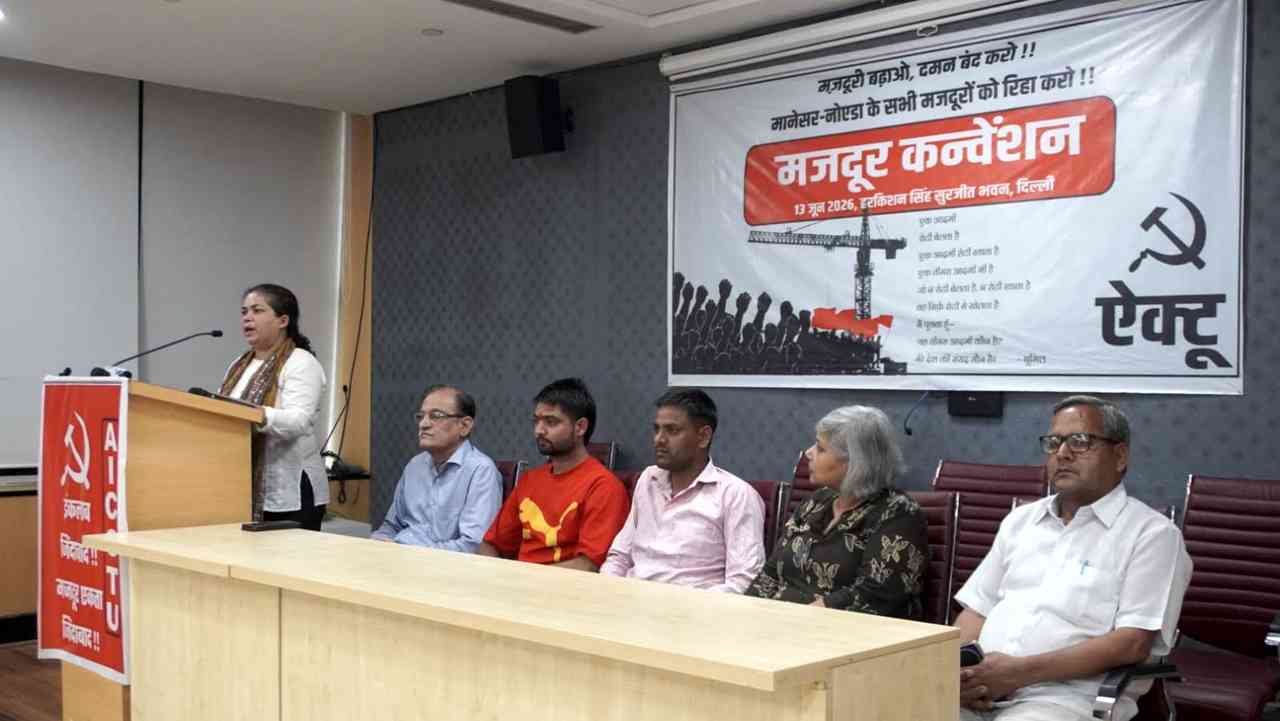
“Whatever repression is unleashed upon us will not break our spirit. We will continue to resist the attempts to impose this modern slavery on the workers,” declared Vivek.
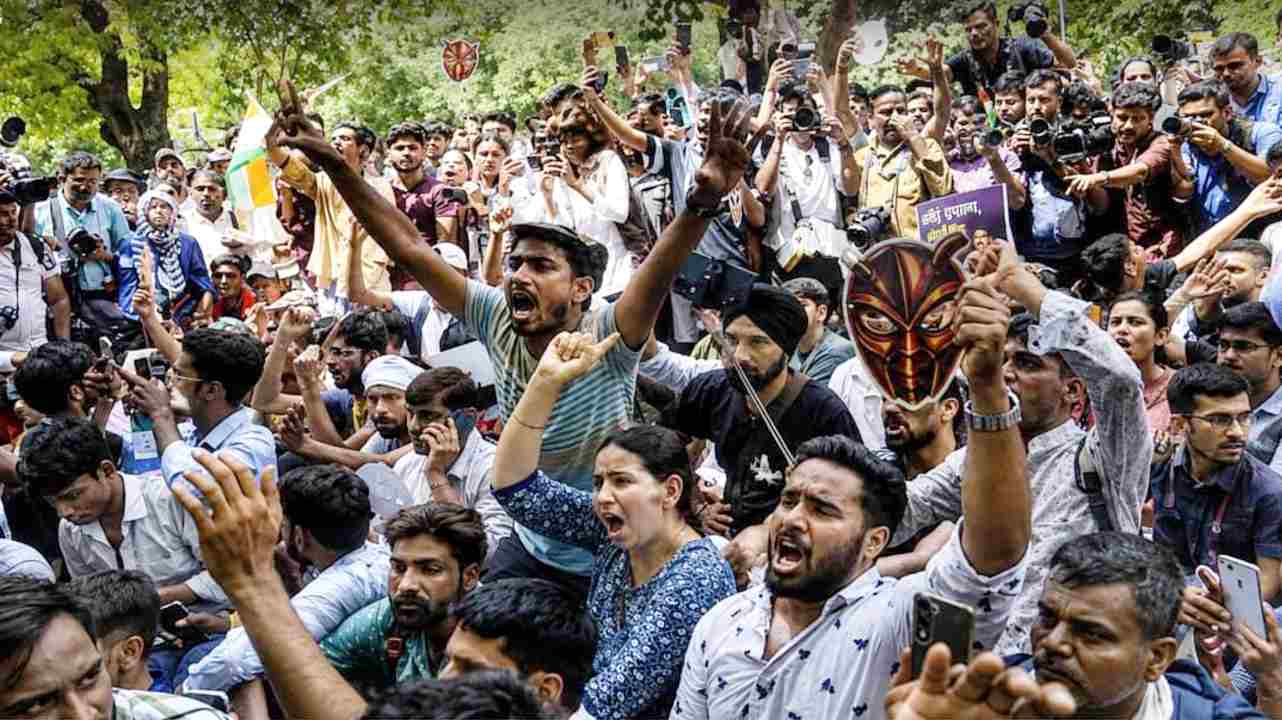
The one-day convention witnessed struggling workers, teachers, students, lawyers, trade unionists and democratic activists uniting in solidarity with the ongoing workers' struggles in Noida, Manesar, Panipat, Surat and other industrial centres.
The convention began by saluting the resolve of the struggling workers and felicitating comrades Vivek and Rajkumar, who were recently released on bail by a court in Gurugram. The entire hall reverberated with the slogans of "Inquilab Zindabad", saluting the indomitable spirit of the struggling workers and declaring: Increase the Wages, No to Repression.
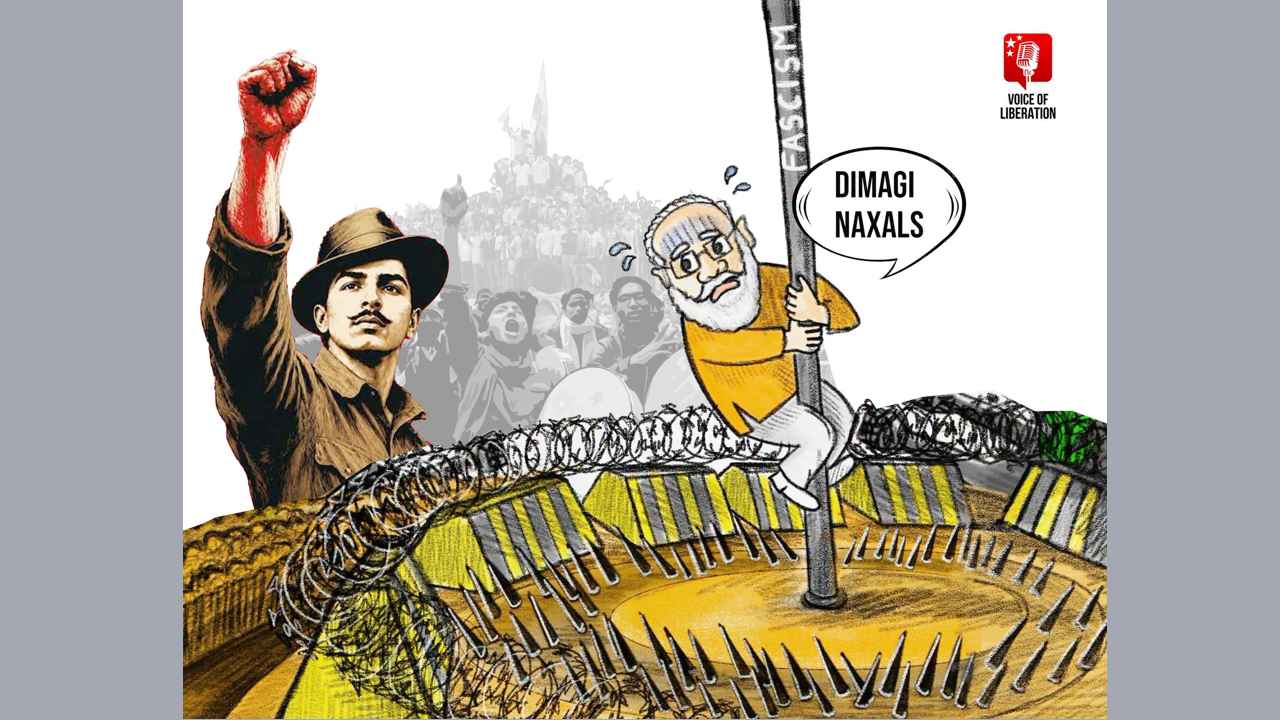
Sucheta De of AICCTU, welcoming workers and activists from across various democratic circles, said that since the Modi government came to power, there has been a complete derogation of workers' rights, with a slew of new laws such as the labour codes being brought in to turn workers into modern slaves and take away their right to strike. Despite all the repression and brutality unleashed by the state-corporate nexus, the struggles of workers from Manesar to Noida, Guwahati to Ahmedabad, have shown that the working class cannot be silenced.
From April 13 to 15, Manesar and Noida in the Delhi-NCR region witnessed a massive workers' uprising protesting against the pittance given to workers in the name of wages, while the state governments turned a blind eye to the large-scale exploitation of workers. In Haryana, minimum wages were last revised in 2015, and when wages were revised on April 1, 2026, the increase was negligible, disregarding the demands of unions that had called for a substantial hike in view of soaring inflation and the rising cost of living.
“We were being given a pittance and even when minimum wages were increased, we were not paid the revised wages. When we protested for the revised minimum wages, we were branded as anti-nationals and put behind bars,” said Raj Kumar, who along with Vivek spent around one and a half months in jail.
Most of the protesting workers in these regions are contract workers across key sectors such as energy, automobiles, garments and associated industries, where large production units employ thousands. They are deprived even of statutory minimum wages, which themselves are insufficient to meet basic monthly expenses given the rise in prices of essential commodities and inflation. Working conditions remain exploitative and degrading, with 12-hour shifts often without breaks and workers required to remain standing throughout. Legally mandated provisions such as double wages for overtime and weekly holidays are frequently denied. In cases of workplace injury or illness, workers often bear medical expenses themselves. A significant issue raised by women workers in Noida concerns sexual harassment and the absence of effective internal complaints mechanisms.
“Red Salute to all the struggling workers,” declared Rajiv Dimri, General Secretary of AICCTU, saluting the determination and courage of the working class. “They were merely protesting for bread and what the BJP government gave them was batons, tear gas and jail. This system of corporate-fascist nexus must be brought to an end,” he added.
Rajiv Dimri further said that amid the working-class upsurge across the country, the Central Trade Unions and Samyukt Kisan Morcha have stood unitedly with the workers and will continue to strengthen the movement of the toiling masses.
On the call of AICCTU, an All India Protest Day was observed on April 17, 2026, against the brutal repression faced by workers in Noida, Manesar, Faridabad, Ghaziabad and across the Delhi-NCR region while protesting against starvation-level wages.
AICCTU has also submitted a demand letter calling for raising minimum wages to at least Rs. 42,000, with calculations based on rising inflation, cost of living and other factors that must be taken into consideration while determining minimum wages.
Comrade Rakhi, a veteran trade union activist, said that while the Indian government projects the country as becoming a trillion-dollar economy, workers in the Delhi region face repression for merely demanding wages. She said it was alarming that more than 1,100 workers had been arrested under various laws, including charges of attempt to murder and even the draconian National Security Act. The arrested workers, including women, were subjected to severe custodial torture. Even today, governments have not provided complete information regarding the number of workers arrested.
She added that workers have opened the battle lines with their resolve and determination, and the Central Trade Unions must strengthen this movement.
Advocate Kawalpreet Kaur, who is defending jailed activists in Noida, highlighted how contractualisation has become a tool to suppress workers' rights and prevent unionisation. The labour codes brought in by the Modi government are aimed at continuing this exploitation and turning workers into modern slaves of the corporates.
She condemned the criminalisation of workers and activists while employers violating labour laws continue to enjoy impunity. Kawalpreet also pointed out how the government is imposing fresh cases against workers currently in jail to ensure that even if they obtain bail in one case, they continue to remain incarcerated in others, creating a vicious cycle of repression through the law. Even artists who went to express solidarity with workers were arrested and jailed.
The convention also witnessed solidarity from workers across various sectors, many of whom are fighting a dual battle for their basic labour rights while also trying to save homes built with their sweat from illegal bulldozer actions by the state.
Shabana, a domestic worker and resident of Dhobi Ghat, saluting the workers of Noida and Manesar, said that it is their toil and hard work that builds this country, yet they are denied basic rights and dignity.
“We may be poor, but we are fighters who struggle every day to survive. We are not disposable!” she added.
“My message is: Don't be afraid, fight!” said Shabana.
Ravi, General Secretary of the RML Hospital Union, which spearheaded a long struggle against the termination of contract workers at RML Hospital in Delhi, said that today workers are witnessing a complete derogation of their rights by a system comprising the government, employers and the Godi media.
“Our only solution to fight this system and win our rights is to unite and strengthen our voices,” he said.
Sunil Valmiki, a security guard from JNU, said that recent developments have shown what workers' unity can achieve. He said that when the security contract in JNU changed, workers were forced to pay bribes to new contractors to retain their jobs, while the JNU administration remained complicit in this corrupt practice.
“We united with the students of JNU and resisted this corruption, and we won. This shows the power of working-class unity!” he said.
Expressing solidarity with the struggling workers, Purushottam Sharma of the All India Kisan Mahasabha (AIKM) said that today worker-farmer unity is challenging the corporate-government conspiracy to take away the rights of the toiling masses. The farmers' movement at Delhi's borders demonstrated that unity remains the strongest weapon in the face of coordinated repression.
Teachers and students also joined the convention, saluting the spirit of the working class. Professor Nandita Narain of Delhi University, expressing gratitude to the workers, spoke about DU students Yogesh Meena and Aakriti Choudhary, who were abducted by the police and jailed for standing with workers. She added that the draconian NSA is being used against activists and workers merely for raising demands for fair wages, while a narrative was peddled that the protests were part of a Pakistani conspiracy.
Danish Ali, Joint Secretary of JNUSU and AISA leader, said that the Modi regime has unleashed repression against workers, youth, women, farmers and every section of society that it seeks to turn into cogs in the wheel of exploitation, a machine run by Adani and Ambani. “We take inspiration from the workers and farmers and their movements. Today the youth are also on the streets against the corruption-ridden education system and paper leaks,” she said.
“The struggles of the workers are the struggles of all,” Danish declared, saluting the workers' movements.
The convention ended with a unanimous demand for a substantial increase in wages, an end to repression, withdrawal of all false cases against workers and activists, and the immediate release of all those jailed for participating in democratic workers' movements.